(VOVWORLD) - Many fishermen in Quang Tri have shifted from fishing to sustainable aquaculture as their fishing vessels fail to meet requirements for offshore fishing. The new trade is expected to help them stabilize income and reduce pressure on marine resources, moving toward a responsible, long-term marine economy.
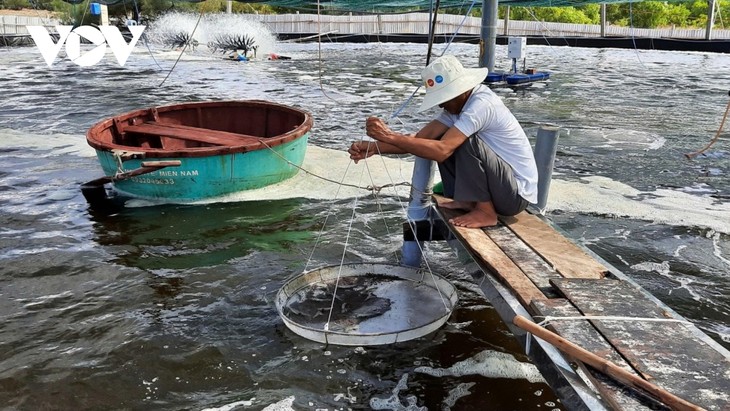 Many fishermen in Quang Tri province have shifted to aquaculture. (Photo: VOV) Many fishermen in Quang Tri province have shifted to aquaculture. (Photo: VOV) |
After many years at sea, Le Xuan Vuong of Hamlet 8, Nam Cua Viet commune, has switched to shrimp farming. With technical support from local authorities, his family has a stable market and a steady income.
“With support and consultation from authorities at all levels, I learned and built a three-stage high-tech shrimp farming model. After two years, I succeeded and earned high income,” said Vuong.
The authorities of Nam Cua Viet commune have zoned more than 800 hectares for aquaculture. Most residents are helped to develop sustainable farming models that generate high income.
Dang Huy Bang, Head of the Economic Division of Nam Cua Viet commune, said the authorities have encouraged fishermen whose vessels are no longer eligible for operation to quickly shift to aquaculture: “We maintain existing aquaculture areas while developing additional two- and three-stage shrimp farming models in a sustainable direction. We have strengthened management of aquaculture and environmental and ecological protection.”
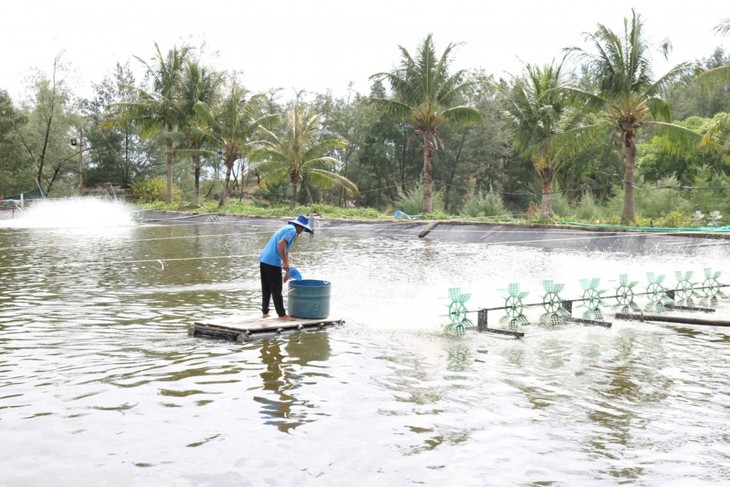 Quang Tri province helps farmers apply the HDPE plastic cage marine fish farming model (Photo: VOV) Quang Tri province helps farmers apply the HDPE plastic cage marine fish farming model (Photo: VOV) |
The Sub-Department of Fisheries and Fisheries Surveillance of Quang Tri province has deployed plans on job replacement for fishermen. Owners of fishing vessels that are outdated, fail to meet safety and technical standards, are supported in selling their vessels or switching to aquaculture, fisheries logistics services, or community-based tourism.
Nguyen Duc Trung, Deputy Head of the Sub-Department of Fisheries and Fisheries Surveillance of Quang Tri province, said: “The province finances aquaculture households with 30% of total infrastructure construction costs and offers incentives for breeding and feed expenses. We inform farmers of environmental and water quality, so that they can decide schedule suitable for intaking into ponds.”
In coastal communes, the provincial Sub-Department of Fisheries and Fisheries Surveillance has instructed farmers to apply the HDPE plastic cage marine fish farming model, giving fishermen an alternative for sustainable aquaculture.