(VOVWORLD) - After one month of fighting between Iran and a US-Israel partnership, the US has proposed a 15-point plan to end the conflict, but the risk of further escalation remains high.
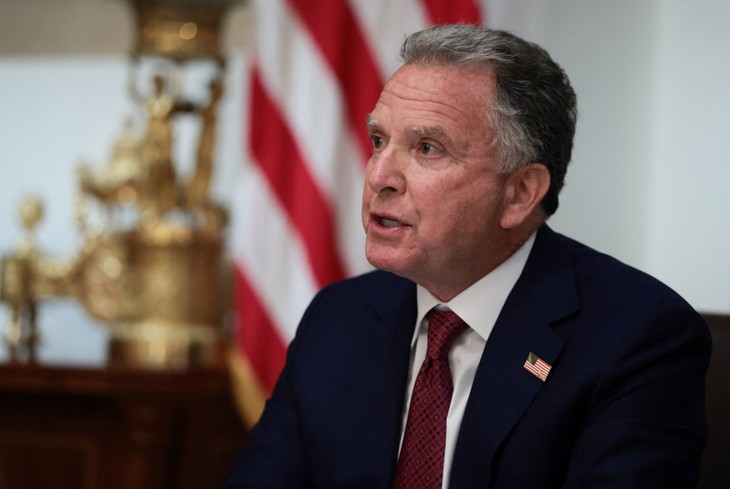 US President’s special envoy Steve Witkoff speaks during a cabinet meeting at the White House on March 26, 2026. (Photo: REUTERS/Evelyn Hockstein) US President’s special envoy Steve Witkoff speaks during a cabinet meeting at the White House on March 26, 2026. (Photo: REUTERS/Evelyn Hockstein) |
The US President’s special envoy Steve Witkoff said Thursday that Washington has sent a 15-point plan to Iran via Pakistan in a diplomatic move to end the Middle East conflict.
Initial developments
The 15-point plan was reported by Western media several days before Witkoff confirmed it on Thursday. While the plan hasn't been publicly disclosed, the US reportedly wants a 30-day ceasefire and is demanding that Iran dismantle its nuclear facilities in Natanz, Isfahan, and Fordow and promise never again to pursue a nuclear weapon.
Washington also demands that Tehran hand over its enriched uranium to the International Atomic Energy Agency, cease all uranium enrichment, allow the IAEA to monitor all remaining nuclear infrastructure, limit its ballistic missile program, and reopen the Strait of Hormuz.
In return, all international sanctions against Iran will be lifted and the US will support electricity production at Iran’s civilian nuclear facility in Bushehr.
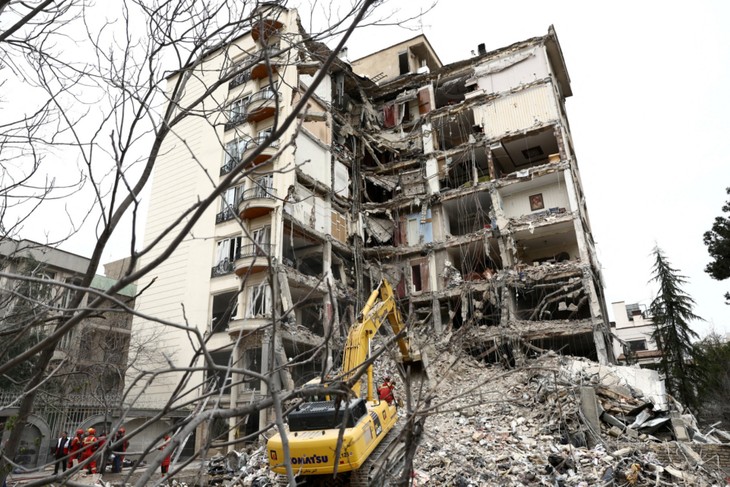 A residential building damaged by a US-Israel airtrike in Tehran, Iran on March 23, 2026. (Photo: Majid Asgaripour/WANA via REUTERS) A residential building damaged by a US-Israel airtrike in Tehran, Iran on March 23, 2026. (Photo: Majid Asgaripour/WANA via REUTERS) |
Mr. Witkoff said: “I can say this, we will see where things lead and if we can convince Iran that this is the inflection point with no good alternatives for them. We have strong signs that this is a possibility and if a deal happens it will be great for the country of Iran, for the entire region and the world at large.”
Iran’s Tasnim News Agency reported Thursday that Tehran has sent an official reply to the plan, which insists that any agreement must begin with the immediate end of military attacks and guarantees that the attacks will not resume. Iran also demands reparations for damages, and an end to the conflict on all fronts, including all groups aligned with Iran throughout the region.
“The US has put forward certain ideas. In some places, there is mention of a 15-point plan, but it is presented as various proposals. All have been submitted to our leadership, and we will state our views if necessary. For now, our policy is to continue resisting and defending our country, and we have no intention of negotiating, nor are any negotiations currently taking place,” Iranian Foreign Minister Abbas Aragchi said.
Raz Zimmt, Director of the Iran Program at Israel’s Institute for National Security Studies, said Iran’s leadership appears interested in a ceasefire, but not at any cost.
High risks of escalation
President Trump on Thursday decided to delay by another 10 days, until April 5, his “ultimatum” to strike Iran’s power facilities if Iran doesn’t lift its blockade of the Strait of Hormuz, in order to give all sides more time to consider diplomatic options.
According to Daniel Levy, a former negotiator for the Israeli government, any dialogue between the US and Iran must take into account Israel’s position. He said the Israeli government has consistently shaped the framework of US-Iran negotiations and can influence their outcomes when necessary.
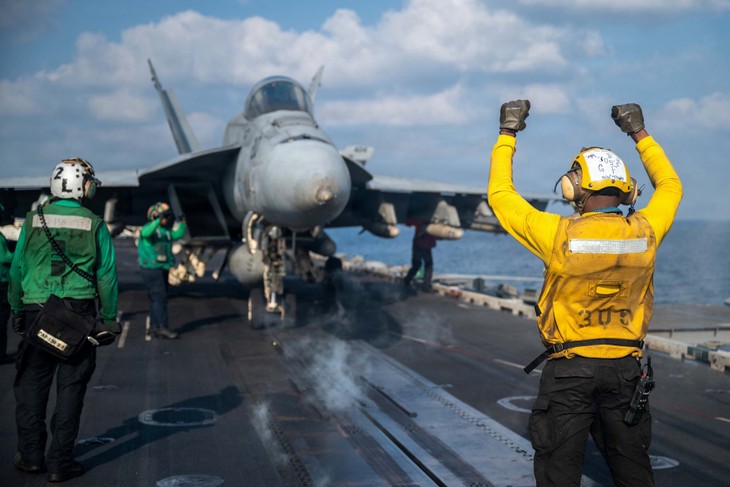 A helicopter aboard a US aircraft carrier takes part in operations targeting Iran. (Photo: REUTERS) A helicopter aboard a US aircraft carrier takes part in operations targeting Iran. (Photo: REUTERS) |
Michael Singh, former Director of the US Security Council on the Middle East and now working at the Washington Institute, said there remains a narrow path for an agreement. If both sides view the cost of conflict as unbearable, they may opt for a limited deal to quickly halt hostilities while setting aside the most contentious issues.
Actually, the risk of military escalation remains very high. Alongside diplomatic efforts, the US continues to strengthen its military presence in the region. About 40,000 US troops have been deployed to the Middle East since the conflict began, with thousands more marines being sent. The White House warned on Wednesday of stronger attacks if Iran does not accept military defeat.
“They have miscalculated the reaction of Iran, which obviously has prepared for that day for more than 40 years. One can of course win a war like that militarily, but the costs are rising every single day, not only when it comes to personnel and for money, but in particular the political price would be extremely high,”Klemens Fischer, professor of international geopolitics at the German University of Cologne, said.
Iranian senior officials remain highly cautious about recent developments. Iran’s Parliament Speaker, Mohammad Bagher Ghalibaf, on Thursday warned of the risk of an invasion of Iran’s Kharg Island, allegedly supported by an unnamed regional country. He said on the X platform that Iranian forces are monitoring all developments and any attack on Iran will trigger retaliation against critical infrastructure of the aggressor.