(VOVWORLD) - Prime Minister Pham Minh Chinh has successfully concluded an official visit to Russia from March 22-25 at the invitation of Russian Prime Minister Mikhail Mishustin. The trip has great strategic significance at a time when the world is being buffeted by complex geopolitical, economic, and energy disruptions.
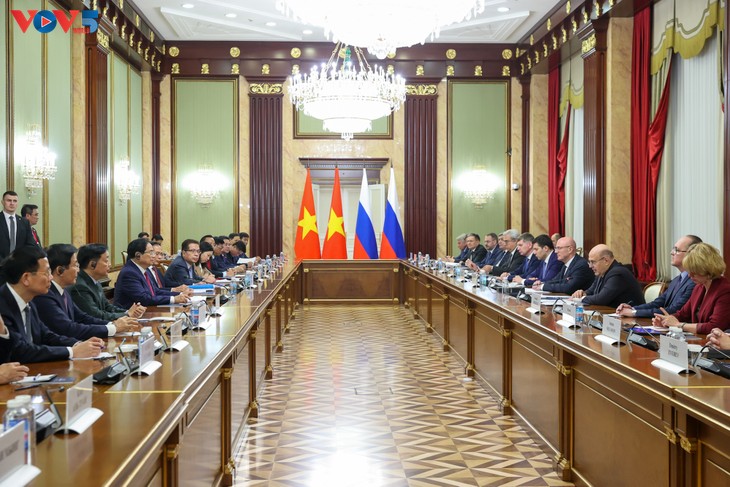 Prime Minister Pham Minh Chinh holds talks with Russian Prime Minister Mikhail Mishustin. (Photo: VOV) Prime Minister Pham Minh Chinh holds talks with Russian Prime Minister Mikhail Mishustin. (Photo: VOV) |
The outcomes of Prime Minister Pham Minh Chinh’s visit to Russia have helped consolidate the traditional partnership and expand cooperation to serve Vietnam’s long-term development goals in the new era.
Key outcomes
The most notable result of the visit was the signing of a cooperation agreement on nuclear power. This marks a breakthrough step amid rising energy demand and increasing pressure to transition to cleaner energy sources. The resumption of nuclear energy cooperation with Russia will help Vietnam diversify its energy supply and enhance its technological capacity in the energy sector. Russia, with its world-leading experience in building and operating nuclear power plants, is a suitable partner with which to learn and transfer technology.
Their cooperation reflects the political trust between the two nations, which has been built on a long-standing historical foundation. With the global order showing increasing polarization, Vietnam’s strengthening of ties with Russia reflects its balanced, independent, and multilateral foreign policy approach.
The nuclear power project has become a new symbol of the Vietnam-Russia relationship. Russian Prime Minister Mikhail Mishustin said: “Following today’s talks, an intergovernmental agreement on building Vietnam’s first nuclear power plant was signed. The project is expected to provide strong momentum for expanding cooperation in related fields, including high technology, as well as fundamental and applied scientific research. I am confident that this project will become a new symbol of the friendship between Russia and Vietnam.”
Energy cooperation is a pillar of the relationship. During Mr. Chinh’s visit, ministries and businesses of the two countries attended a meeting on liquefied natural gas, a field of untapped potential. Expanding cooperation with Russia will provide Vietnam with more options to ensure energy security amid the fluctuations of the global energy market.
The visit also promoted Vietnam-Russia cooperation in other areas, such as science and technology, education and training, digital transformation, and biomedicine. These areas are of strategic importance to Vietnam’s development in the new era.
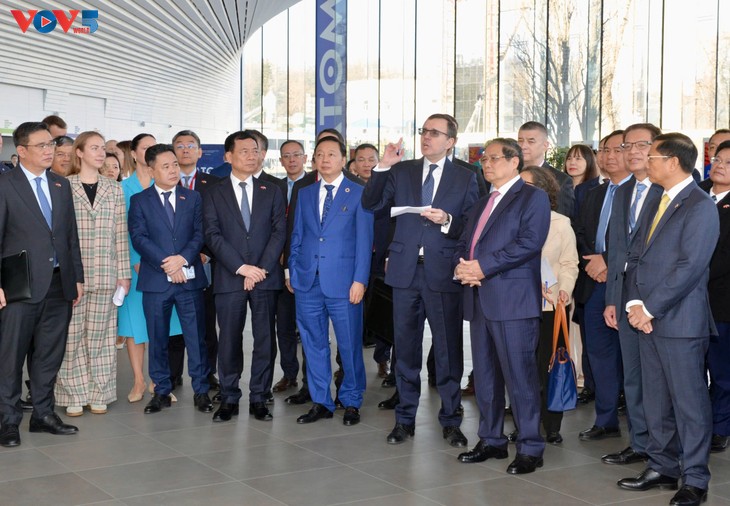 Prime Minister Pham Minh Chinh visits the Atomic Energy Museum. (Photo: VOV) Prime Minister Pham Minh Chinh visits the Atomic Energy Museum. (Photo: VOV) |
Elevating Vietnam–Russia relations
Talks between Prime Minister Chinh and his counterpart Mikhail Mishustin reaffirmed a determination to elevate the two countries’ comprehensive strategic partnership. In an increasingly complex world, stable and trustworthy Vietnam–Russia relations will help Vietnam maintain a peaceful, stable environment for development.
The visit has opened up new opportunities for businesses in both countries. Although bilateral trade turnover has yet to reach its full potential, newly signed agreements are expected to boost Vietnam’s diversification of markets and reduce its dependence on other traditional partners.
During the visit, the two Prime Ministers agreed to promote exchange activities within the framework of the 2026 Year of Science and Education, expand projects in information technology and artificial intelligence, and broaden scientific research cooperation within the framework of the Vietnam-Russia Tropical Center. Russia will provide consulting, design, and technology transfer for metro system construction in Hanoi and Ho Chi Minh City.
The visit clearly demonstrated Vietnam’s proactive foreign policy. In a rapidly changing world, no country can rely on just one or a few partners. Maintaining strong relations with multiple countries, including major powers like Russia, will give Vietnam greater flexibility in responding to challenges.