(VOVWORLD) - Vietnam and China have over the past years continued to strengthen relations along their land border in the interest of peace, stability and cooperation. Through legal documents and practical cooperation mechanisms such as the Border Defense Friendship Exchange Program, the two countries are enhancing coordination in border management and protection and strengthening ties between border communities.
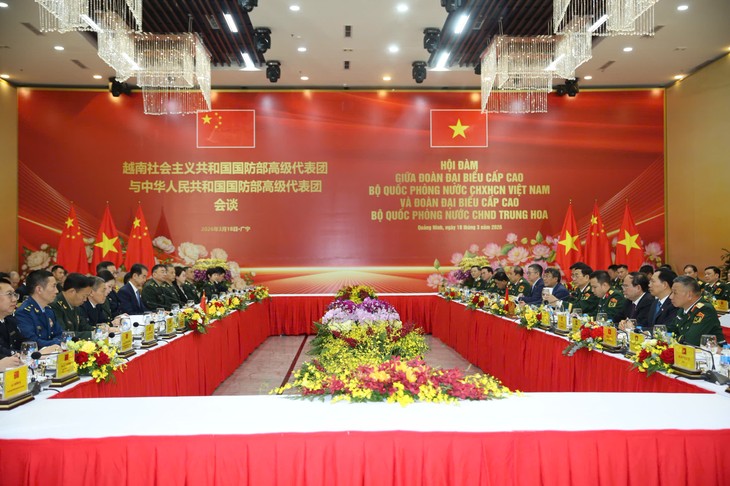 Talks between high-level delegations of Vietnam and China. (Photo: Le Phuong/VOV5) Talks between high-level delegations of Vietnam and China. (Photo: Le Phuong/VOV5) |
Vietnam and China share a border on land and at sea. The land border, 1,449 km long, separates Vietnam’s provinces of Quang Ninh, Lang Son, Cao Bang, Tuyen Quang, Lao Cai, Lai Chau, and Dien Bien from China’s Guangxi Zhuang Autonomous Region and Yunnan province. This border line is of great importance in national defense and security, economic development, and people-to-people exchanges for both countries, so cooperation in border management, protection and development is a priority for both.
A solid legal foundation for a peaceful and friendly border
To maintain the current peaceful border, Vietnam and China have conducted 30 years of negotiations, addressing numerous technical issues, historical complexities, and other challenges.
The Land Border Treaty, signed by the two countries on December 30, 1999, which took effect on July 6, 2000, created a solid legal basis for border management and protection. On that foundation, the two sides began border demarcation and marker planting and issued a Joint Statement announcing the completion of the work on December 31, 2008.
On November 18, 2009, in Beijing, the two countries signed 3 legal documents – the Protocol on Vietnam-China border demarcation and marker planting, the Agreement on Vietnam-China border management regulations, and the Agreement on Vietnam-China border gates and regulations on the management of border gates. These 3 documents took effect on July 14, 2010.
Dr. Tran Cong Truc, former Head of the Government Border Committee, said: “These documents clearly defined a border demarcated by a comprehensive system of boundary markers, all governed by legal documents.”
The border areas of the two countries have been quite stable; the boundary markers have been well maintained; security and order have been ensured; and cross-border travel and trade have become smoother. The border gates and transportation infrastructure have been improved to facilitate exchanges and cooperation and improve the living conditions of border residents. These results are a solid foundation on which to base a peaceful, friendly, sustainably developing border.
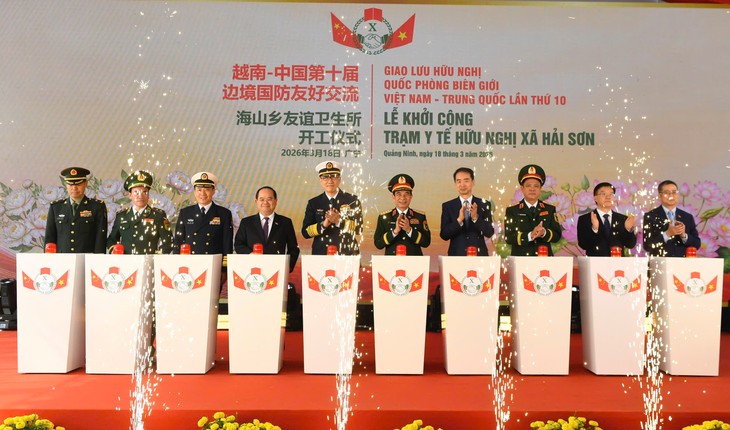 The ground-breaking ceremony of the Friendly Health Center in Hai Son commune (Photo: Le Phuong/VOV5) The ground-breaking ceremony of the Friendly Health Center in Hai Son commune (Photo: Le Phuong/VOV5) |
Border Defense Friendship Exchange Program connects neighbours
The annual Vietnam-China Border Defence Friendship Exchange Program, first held in 2014, has become a highlight of bilateral defence cooperation, reflecting the strong political will and sense of responsibility of the two militaries in building a stable, cooperative, jointly developing border.
The 10th Vietnam-China Border Defence Friendship Exchange Program is taking place on Wednesday and Thursday with a range of activities that affirm its role as an important cooperation mechanism between the two border forces and Ministries of National Defence.
Colonel Do Duy Chinh, Deputy Director of the Department of Propaganda and Training of the General Department of Politics of the Vietnam People’s Army, said: “The 10th exchange is of particular significance, directly contributing to strengthening political trust, fostering friendship and solidarity between the militaries and peoples of Vietnam and China. It promotes substantive cooperation between border protection forces, local authorities, and communities, and contributes to building a peaceful, friendly, stable, cooperative, and developing Vietnam-China border.”
The program’s diverse activities address the practical needs of the border areas. Diplomatic activities such as high-level talks and joint patrols, and humanitarian initiatives such as medical check-ups, livelihood support for border residents, and scholarships for disadvantaged students, are directed toward strengthening coordination between functional forces, improving people’s livelihoods, and reinforcing mutual trust.
Medical exams and other healthcare services demonstrate a spirit of substantive humanitarian cooperation. Major Xiao Jun, Head of a Chinese military medical delegation providing medical services in Vietnam, said: “This activity deepens medical cooperation between the two countries’ militaries and symbolizes mutual support and people-to-people bonding. Border security and public health are shared aspirations and responsibilities of the two sides.”
These activities directly benefit local people, strengthen trust between the militaries, authorities, and citizens of both countries, and spread a spirit of friendship along the entire border.