(VOVWORLD) - New Zealand’s Parliament Speaker Gerry Brownlee is paying an official visit to Vietnam from August 27-31, at the invitation of National Assembly Chairman Tran Thanh Man. The visit reaffirms the two countries’ determination to elevate their Comprehensive Strategic Partnership in the new era.
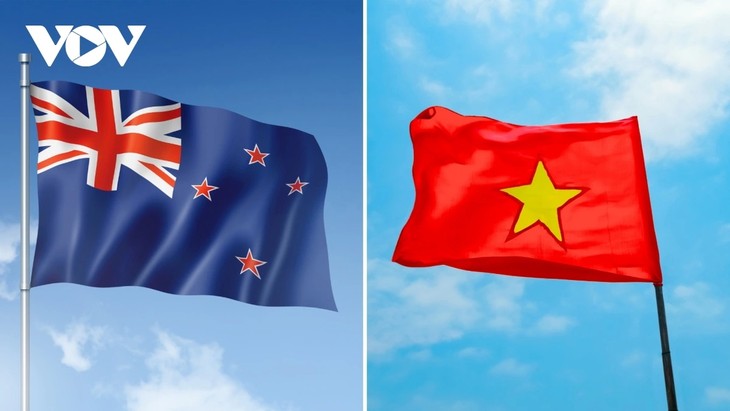 The flag of New Zealand and flag of Vietnam The flag of New Zealand and flag of Vietnam |
Major milestones over the last 50 years
Since diplomatic ties were established in 1975, Vietnam-New Zealand relations have seen many remarkable achievements. After a “Joint Statement on Cooperation” in 2005, bilateral ties were upgraded to a Comprehensive Partnership in 2009, to a Strategic Partnership in 2020, and to a Comprehensive Strategic Partnership in February in 2025.
Shared interests and political determination have been the key factors for the development of bilateral ties between the two countries. Bilateral trade turnover has grown steadily over the years, reaching 1.3 billion USD in 2024, making Vietnam New Zealand’s 12th largest trading partner. The two countries are aiming to raise bilateral trade to 3 billion USD in 2026. Bilateral cooperation in education, training, agriculture, labor, and transportation has also achieved strong results.
Their two peoples have developed an increasingly close friendship. The Vietnamese community in New Zealand, numbering about 14,000, serves as a bridge of friendship connecting the two nations. Many overseas Vietnamese, including intellectuals, experts, and scientists, maintain strong ties with their homeland and wish to make practical contributions to bilateral relations. Vietnam and New Zealand have closed closely at multilateral mechanisms, most notably ASEAN–New Zealand.
Potential for expanded cooperation
Building on growing political trust and the development of bilateral ties over the past five decades, leaders and experts from both countries agree that there is great potential for further cooperation, with economics considered the pillar.
Vietnam’s rapid growth has made it an attractive destination for New Zealand businesses and investors, said New Zealand Prime Minister Christopher Luxon said during his official visit to Vietnam in February.
“This country is a rising star in Southeast Asia. It has been the fastest growing economy in the region for the last 25 years and will be for the next decade. That makes it one of the top export growth opportunities for New Zealand. When we trade with countries like Vietnam, we're growing our economy at home and of course that means more jobs and higher incomes for kiwis, or in other words, that just simply means we're putting more money in your back pocket. It means a bigger economy which also means better schools and more hospitals,” said Mr. Luxon.
Vietnam’s digital economy is growing nearly 20% annually, having one of the fastest-developing digital infrastructures in the Asia-Pacific. New Zealand has high expertise in artificial intelligence, digital inclusion, high-tech agriculture, and renewable energy. Both countries are members of the Comprehensive and Progressive Agreement for Trans-Pacific Partnership (CPTPP) and the Regional Comprehensive Economic Partnership (RCEP), which offer numerous opportunities to expand trade and investment cooperation.
Liz Bell, Executive Director of the ASEAN–New Zealand Business Council, said: “From a New Zealand perspective we are obviously very strong, and have been for a number of years, have value added FNB food and beverage sector. We're also looking at a lot of services as well which is not so easily tracked but across climate change, renewable and infrastructure, and science and technology sectors, which I think are very complementary. We have a lot of scope there to increase.”
Vietnam-New Zealand relations are reinforced by shared diplomatic values. They have participated in regional institutions and are committed to international law, open trade, and regional peace and stability. These similarities have contributed to enhancing strategic trust between the two countries helping them coordinate effectively at multilateral forums.
What matters most now is to identify the most promising areas of cooperation and exploit them through concrete projects which will be discussed during Speaker Brownlee’s visit. A deeper, more focused partnership will benefit their peoples and contribute to regional peace, stability, and sustainable development.