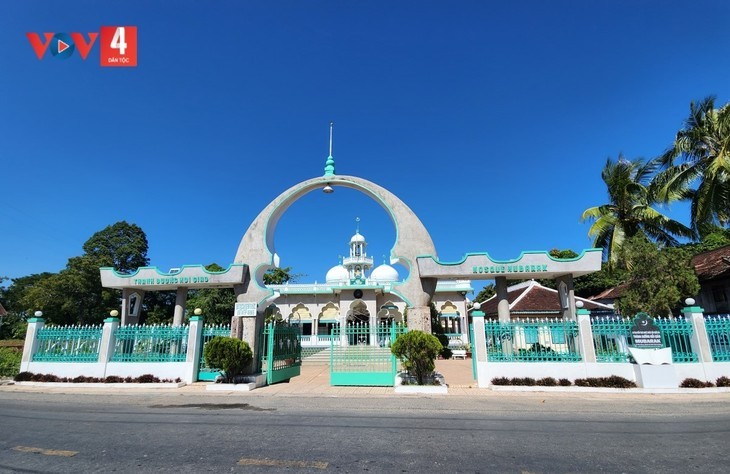
 Mubarak mosque in Chau Phong commune, An Giang province (Photo: Do Quyen/VOV4) Mubarak mosque in Chau Phong commune, An Giang province (Photo: Do Quyen/VOV4) |
B: Here’s an email from Sami Mosaad of Egypt, who writes: “I’d like to express my appreciation for your wonderful Mailbox program, which I always enjoy listening to. It brings us closer to Vietnam and helps us learn more about its rich culture and diverse society. I’d like to ask about the Muslim community in Vietnam. Could you please tell me approximately how many Muslims live in Vietnam? Are there many mosques across the country? And what is the largest mosque in Vietnam?”
A: Thank you very much, Sami, for your kind words and thoughtful question. According to the Committee for Religious Affairs of the Ministry of Ethnic and Religious Affairs, Vietnam is home to around 70,000 to 80,000 Muslims. Islam in Vietnam has developed into two main branches.
B: The community that follows relatively orthodox Islamic teachings, known as Cham Islam, is concentrated in An Giang, Ho Chi Minh City, several Mekong Delta provinces, and Hanoi.
A: The community that practices a localized form of Islam known as Cham Bani lives mainly in Khanh Hoa, Lam Dong, and Dong Nai province.
B: There are dozens of mosques across Vietnam, along with many smaller prayer houses. One of the largest and best-known mosques in Vietnam is the Mubarak Mosque in An Giang province, which resembles an ancient Arabian or Persian mosque, with rounded domes, tall minarets, and the crescent moon symbol of Islam.
B: Mubarak Mosque is recognized as a National Historical and Cultural Relic. It was designed by Indian architect Mohamet Amin and built in 1750. After several renovations, in 1965 it was reconstructed using reinforced concrete, a structure that stands today.
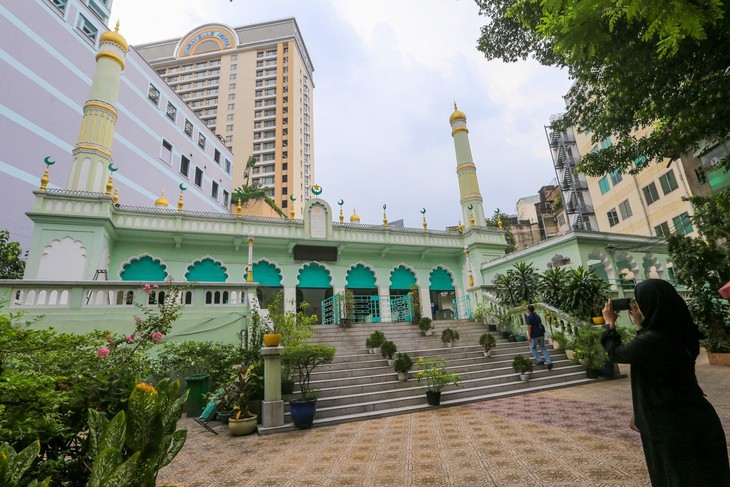 The Saigon Central Mosque, also known as Jamia Al-Musulman Mosque, at 66 Dong Du Street (Photo: dantocphattrien.vietnamnet.vn) The Saigon Central Mosque, also known as Jamia Al-Musulman Mosque, at 66 Dong Du Street (Photo: dantocphattrien.vietnamnet.vn) |
A: In Ho Chi Minh City, you can find several prominent mosques, such as the Saigon Central Mosque and the Jamiul Muslimin Mosque, which are popular places of worship for both local and visiting Muslims.
B: The Saigon Central Mosque, also known as Jamia Al-Musulman Mosque or Đông Du Mosque, at 66 Đông Du Street, was built in 1935 by South Indian Muslim traders, making it one of the oldest mosques in the city.
A: The mosque is easy to recognize, thanks to its white and pale green façade and four slender minarets. Despite being surrounded by busy streets, it provides a very peaceful atmosphere inside.
B: The Jamiul Muslimin Mosque, at 52 Nguyễn Văn Trỗi Street, like many mosques in the city, is not only a place for prayer but also a cultural and social hub for a diverse Muslim community, including people from Indonesia, Pakistan, India, and the local Cham community.
A: These mosques highlight the cultural diversity of Ho Chi Minh City and give visitors a chance to get to know the Muslim community in Vietnam.
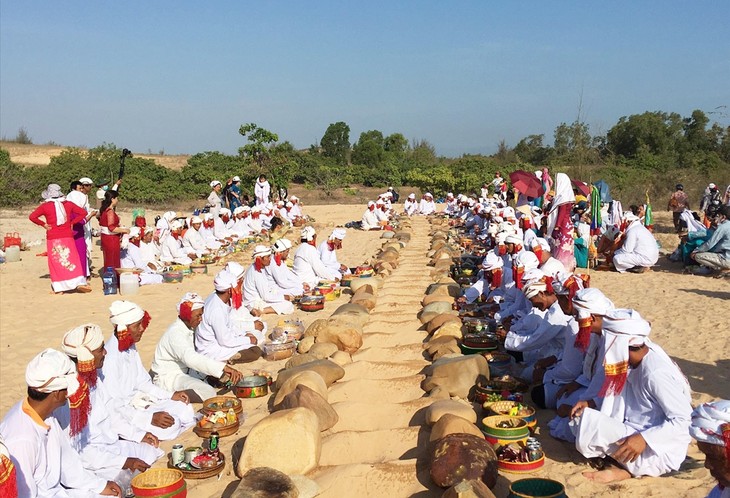 An important ritual during the Ramuwan New Year of the Cham in Binh Thuan is the grave-visiting ceremony to pay respects to ancestors. (Photo: dantocphattrien.vietnamnet.vn) An important ritual during the Ramuwan New Year of the Cham in Binh Thuan is the grave-visiting ceremony to pay respects to ancestors. (Photo: dantocphattrien.vietnamnet.vn) |
B: On the same topic, listener Saeful Fahmi of Indonesia asks how the Muslims in Vietnam celebrate New Year?
A: In Vietnam, Muslims celebrate the New Year in a way which usually features quiet reflection and prayers. The first day of the first month (Muharram) is expected around June 16 this year.
B: Muslims in Vietnam also take part in Tet, Vietnam’s traditional Lunar New Year, especially those who live in a mixed community. They clean and decorate their homes, prepare special dishes, and spend time with their family, while still maintaining their religious practices.
A: By celebrating both their own religious New Year and Vietnam’s traditional Tet holiday, Muslims in Vietnam blend their religious identity with cultural integration.
B: We hope that answers your question, Sami. We thank you once again for writing to us. Now let’s all relax with “Weaving silk under the moonlight”, a musical piece that beautifully blends indigenous Cham culture with Islamic beliefs.
A: Let’s continue with more letters and feedback from our listeners. Here’s an email from Spanish listener Juan Diez, who expresses his delight at receiving a New Year letter and card from VOV.
B: He wrote: “Thank you very much for the beautiful postcard featuring the poetic Hoai River and the stunning scenery along its banks, the brilliant red sky illuminating the fertile land nourished by the river and abundant winter rains. In Vietnam, everything feels joyful and optimistic, reflecting great hopes for the future.”
A: We’re happy to know you received our Lunar New Year card and liked it. This year, we sent New Year greeting cards to our listeners around the world. We know international mail can take quite a long time to arrive, so we’re happy to hear that our greetings have reached your home safely.
B: Listener Shin Makino of Saitama prefecture, Japan, told us: “As a long-time listener, I’m very proud to witness the changes and development of Vietnam’s radio programs over time. In this era of digital transformation, I hope VOV will continue to uphold its long-standing values while also innovating to keep pace with social trends.”
A: Thank you very much, Shin Makino. You’ve been following our programs and watching our development. We will surely continue to uphold the values of traditional radio broadcasting, which have been at the heart of VOV for decades. At the same time, we’re expanding our presence on digital platforms to better connect with listeners around the world.
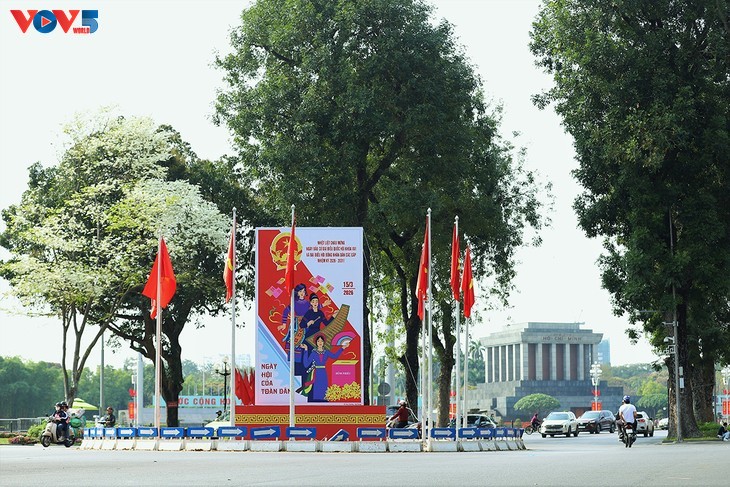 Voting in the National Assembly elections in Vietnam is voluntary. Voting in the National Assembly elections in Vietnam is voluntary. |
B: Now here’s a question from French listener Jacques Augustin. He asks: “Is voting in National Assembly elections compulsory in Vietnam?”
A: That’s a very interesting question. In Vietnam, voting is not compulsory by law. It’s deemed a fundamental right of citizens by our Constitution and our Law on Elections.
B: Voting is considered a civic duty and responsibility and citizens are encouraged to take part, as voting is a way to make their views known and contribute to Vietnam’s political life.
A: 72 million people cast their ballots in Vietnam’s March 15 National Assembly and People’s Council election, a turnout of 99.7% – the highest rate ever recorded.
B: In short, voting in Vietnam is voluntary, but strongly encouraged as both a right and a responsibility of every citizen.
A: And that brings us to the end of today’s Letter Box. Thank you so much for all your letters, emails, and messages. Please keep writing to us and sharing your thoughts about our programs and stories from your part of the world.
B: Your voices are always welcome here at VOV. They help us make our programs better and more engaging. Until next time, take care and stay tuned to VOV.