


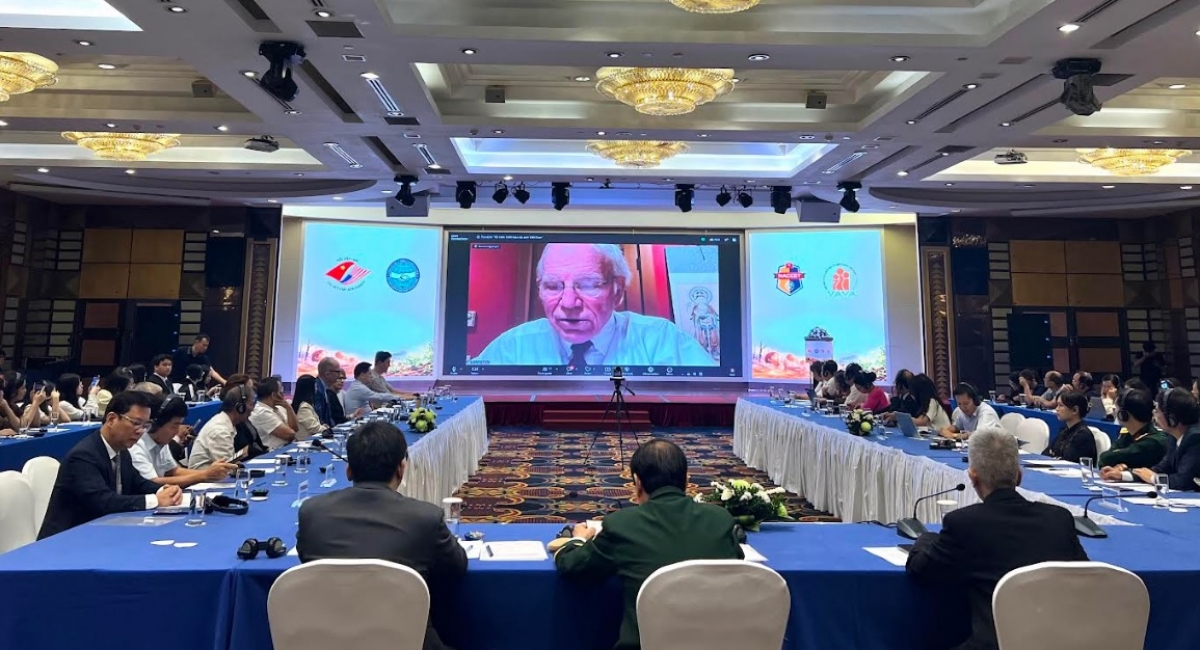
Participants discussed assistance for Agent Orange victims, the role of international nongovernmental organizations, and efforts to address the lasting effects of Agent Orange and dioxin.
Ambassador Bui The Giang, vice president of the Vietnam–US Society, stressed the need to turn goodwill into actions for humanitarian programs. "The Vietnam–US Society calls on our international friends and partners, particularly the US government, Congress, businesses, and the American people, to enhance support for Vietnamese Agent Orange victims," he added.
"We urge US chemical companies that were involved in producing toxic chemicals for use during the war to demonstrate their social responsibility in meaningful and effective ways by participating in programs to support victims, clean up contaminated areas, and address the war’s lasting consequences," said Mr. Giang.
Lieutenant General Nguyen Huu Chinh, president of the Vietnam Association for Victims of Agent Orange/dioxin, said his organization is expanding global cooperation. "Since 2024, we have worked with 150 international delegations, helping strengthen people-to-people diplomacy. A notable event was the signing of an agreement in principle with the Aquitara Foundation of Belgium."
"We have received representatives of various international organizations such as the US Veterans For Peace organization and Japan’s Seeds of Hope project and those from the US, Belgium, France, the UK, Switzerland, Japan, South Korea, Sweden, Thailand, and other countries to learn about the Agent Orange consequences in Vietnam and worked together to ease the suffering of its victims," Chinh said.
Vietnam has approximately 3 million Agent Orange/dioxin victims. Available figures indicate that, as of 2024, more than 35,000 victims were third-generation descendants and more than 6,000 were fourth-generation descendants.