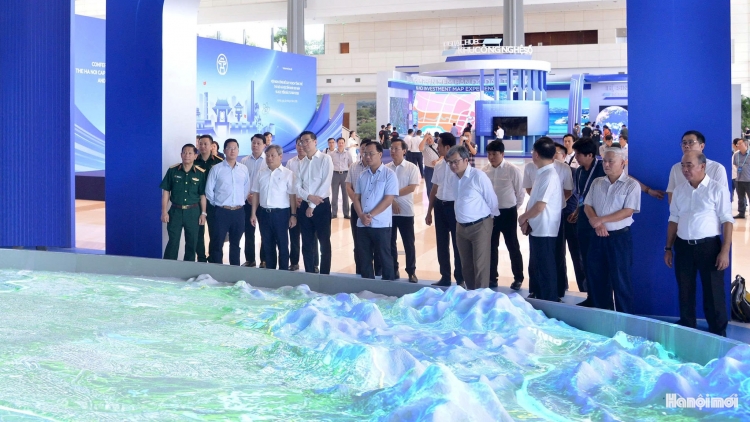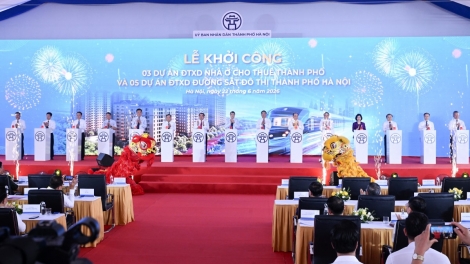



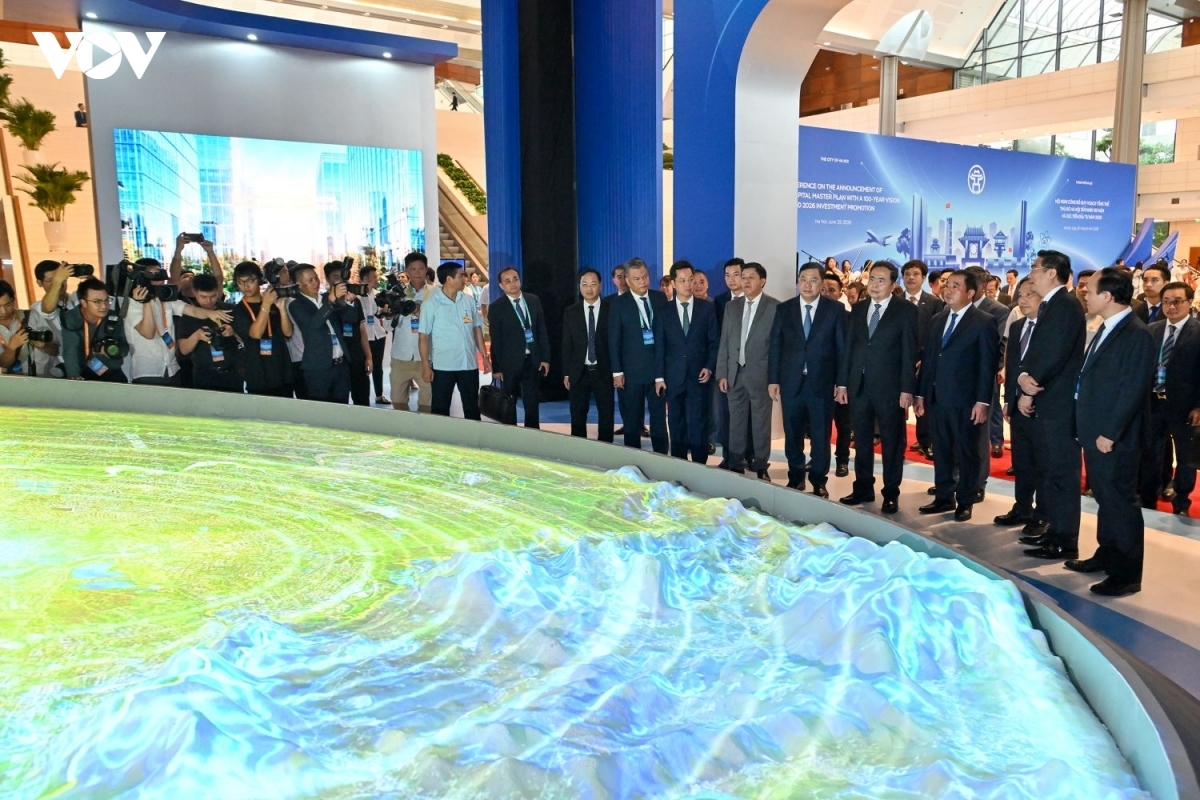
The event was organized by the Hanoi People's Committee and attended by more than 1000 delegates, including representatives from domestic and international corporations and businesses.
Chairman Man said that according to the Capital City Law effective from July 1, 2026, Hanoi is granted many special mechanisms on decentralized management, resource mobilization, infrastructure investment, urban development, science and technology, and investment attraction. This is a historic opportunity for Hanoi to successfully implement the Hanoi master plan with a 100-year vision, he said.
“To realize the established development vision, Hanoi needs to deeply understand that the planning is only truly valuable when it is effectively implemented. Hanoi needs to quickly transform the orientations into specific programs, projects, and works. The effectiveness of implementation and improvement of people's lives must be barometers of governance capacity.”
The top legislator suggested that Hanoi prioritize attracting investment in high value-added sectors with significant spillover effects. They are strategic transportation infrastructure; high technology, semiconductors, artificial intelligence, data centers; new-generation industrial parks; smart logistics; clean energy; circular economy; cultural industries; tourism; and high-quality healthcare and education.
"I hope that businesses and domestic and foreign investors will continue to place their trust in Vietnam and Hanoi, with a spirit of long-term cooperation, responsible investment, respect for the law, and linking the interests of businesses with the interests of the nation and sustainable development of the capital," Mr. Man said.
"Vietnam always considers the success of the business community as one of the important driving forces to promote growth and enhance the competitiveness of its economy. The National Assembly will always stand alongside and listen to the practical experiences from Hanoi to create a solid legal foundation for businesses to confidently invest, innovate, and develop sustainably in Vietnam," he added.
According to the Hanoi master plan with a 100-year vision, the administrative area of the capital city will cover nearly 3,360 km², with a population of 14-15 million people by 2035 and 17-19 million people by 2065.
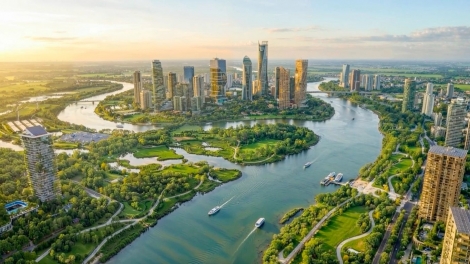
Hanoi uses the Red River as the main ecological and cultural landscape axis, comprising nine development poles, nine major centers, and nine driving axes. In its a 100-year vision, Hanoi aims to become a global city that is "cultural-smart-creative-ecological," belonging to the group of capital cities with the highest quality of life and happiness in the world.
Under the Hanoi master plan with a 100-year vision, from 2026 to 2035, the city aims for an average annual Gross Regional Domestic Product (GRDP) growth of over 11%, reaching 200 billion USD by 2035 and 640 billion USD by 2045.
Hanoi focuses on developing regional linkages following the "core-satellite" model; building an urban railway system with a total length of 1,153 km; establishing special institutions at growth poles: a free trade zone associated with the Northern Airport City and the Hoa Lac Science and Technology City; the Red River Landscape Boulevard - a new symbol of the capital's development; along with the planning orientation for the second airport in the Southern Capital Region and solutions for building a smart, green, and sustainable city, aiming for a net-zero emission goal.
The simultaneous organization of the 2026 Investment Promotion Conference and the announcement of the Hanoi master plan with a 100-year vision sends a strong message of Hanoi's determination to continue institutional reform, improve the investment and business environment, promote the development of strategic infrastructure, science and technology, innovation, digital transformation, green growth, and deep international integration.