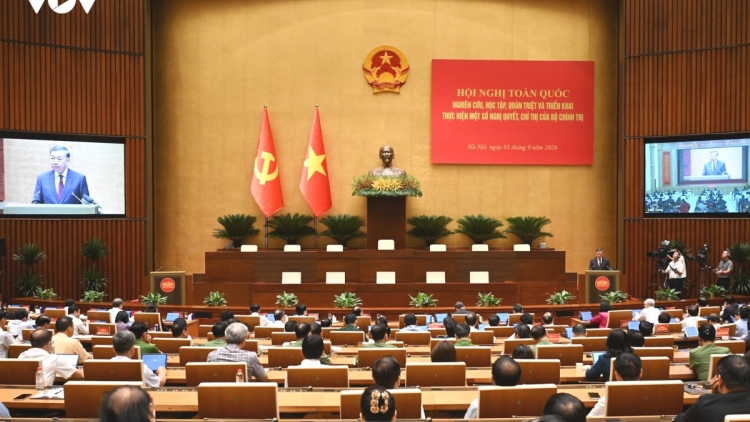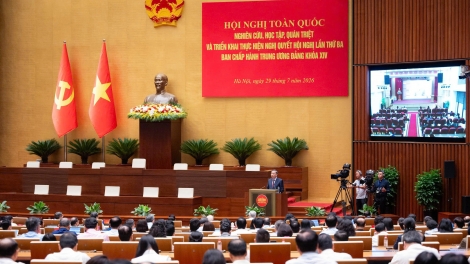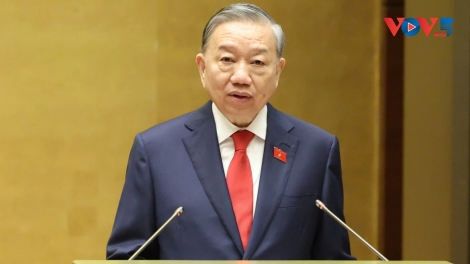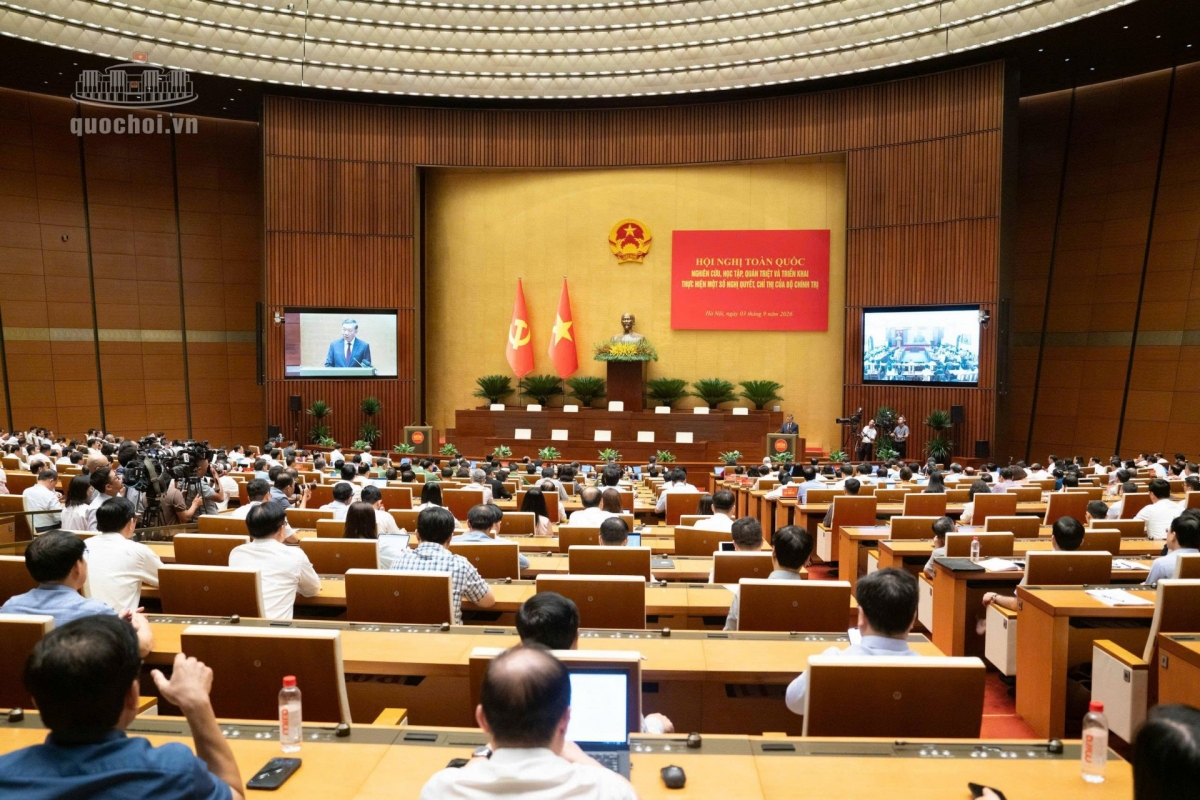
The conference examined the six recently issued resolutions and directives, covering ideological work; the study and practice of President Ho Chi Minh’s thought, morality, working methods, and style; promoting the pioneering and exemplary role of officials and Party members, along with a spirit of innovation and the courage to think, act, and take responsibility. Other disseminated resolutions include overseas Vietnamese affairs; regional development and the organization of national development space; and making tourism a spearhead economic sector.
Taken together, these topics address the fundamental question of how Vietnam should prepare and organize its resources to achieve faster, more sustainable, and higher-quality development.
Strategic vision and consensus from central to grassroots level
The Politburo’s decision to organize a major conference linking the National Assembly with provincial and grassroots-level locations nationwide, demonstrates a strong political determination to build unity of awareness and action. In modern diplomacy and international integration, a country’s soft power stems from domestic consensus, clarity, and transparency in policy direction and implementation seamlessness.
By ensuring that major policies on ideological strategy, regional development, national development, and spearhead economic sectors are understood and implemented consistently, Vietnam is sending a strong message to the international community: it is a united, disciplined, proactive, and reliable country.
The six core topics discussed at the conference offer new perspectives on national development amid profound global changes. A resolution’s focus on development space and regional connectivity aims to overcome fragmentation caused by administrative boundaries and make more effective use of national resources. From the perspective of foreign affairs and international economic integration, a country with coordinated economic planning and well-connected infrastructure is better positioned to attract strategic global investment and a new generation of foreign direct investment.
Meanwhile, the positioning of tourism as a spearhead economic sector in the new era underlines Vietnam’s commitment to openness and deeper international integration, placing people and culture at the center to attract international visitors and enhance the country’s image and standing.
The resolution on overseas Vietnamese affairs further strengthens the great national unity bloc. The more than six million Vietnamese living abroad are not only a valuable source of knowledge, expertise, and financial resources for socio-economic development, but are also “ambassadors of peace” promoting friendship and cooperation between Vietnam and countries around the world.
Prof. Dr. Nguyen Tuan Anh, Editor-in-Chief of the Social Sciences and Humanities Journal at Vietnam National University, Hanoi, said: “In my view, the outstanding strategic vision of these resolutions and directives lies in the shift from developing individual sectors to building an ecosystem for national development, in which people, institutions, development space, and social resources are interconnected."
"I’m particularly struck by the importance placed on people and their capacity to act. Development requires not only capital, technology, and infrastructure, but also social trust, consensus, and a contingent of officials who dare to think, act, and take responsibility, as well as the ability to mobilize resources at home and abroad. The approach to regional development and the reorganization of national development space aims at strengthening connectivity, leveraging the strengths of each locality, and using national resources more efficiently. I would sum up the vision in three keywords: people, connectivity, and development,” said Prof. Dr. Nguyen Tuan Anh.
Reinforcing willpower and seizing opportunities
The conference highlighted the promotion of the pioneering and exemplary role of officials and Party members, encouraging them to innovate and dare to think, act, and take responsibility. It also addressed the ideological work strategy and the Politburo’s directive on stepping up the study and practice of Ho Chi Minh’s thought, morality, working methods, and style during the country’s new phase of development.
This spirit is particularly important in foreign affairs and international integration. The world is facing increasingly complex non-traditional security challenges, intensifying strategic competition and rapid shifts in global supply chains. A dynamic public administration, backed by officials willing to innovate and take decisive action in the common interest, will enable Vietnam to adapt more flexibly, seize opportunities more quickly, and manage bilateral and multilateral relations more effectively.
Assoc. Prof. Dr. Dao Duy Quat, former Standing Deputy Head of the Central Commission for Ideology and Culture, which is now the Commission for Publicity of the Party Central Committee, said: “The issuance of Politburo Resolution No. 25 on the ideological work strategy at this point is both timely and appropriate. It is timely because Vietnam is implementing the Resolution of the 14th National Party Congress and entering a new era – an era of national rise aimed at becoming a developed, high-income country and steadily advancing towards socialism. It is appropriate because the resolution fully recognizes the important role of ideological work."
"The Politburo has once again strongly affirmed that ideological work is an especially important component of the Party’s overall leadership. It must ‘pave the way in advance, accompany implementation, and follow up by summing up practical experience’. This approach is aimed at building a high degree of unity within the Party, strengthening consensus throughout society, and inspiring a powerful aspiration to realize President Ho Chi Minh’s wishes and the path chosen by the nation,” added Mr. Quat.
From strengthening the ideological foundation and encouraging officials to “dare to think and dare to act”, to optimizing national development space, harnessing national unity strength and positioning key economic sectors, these priorities together form a solid foundation for Vietnam’s internal strength.
When consensus and policy implementation are aligned from the central to the grassroots level, Vietnam will be better equipped, not only to address the challenges of faster and more sustainable domestic development, but also to demonstrate the willpower of a stable, proactive nation and a reliable and responsible partner.