





 Vietnamese
 中文
中文
 日本語
日本語
 한국어
한국어
 Français
 Русский
 Deutsch
 Español
 Bahasa Indonesia
 ไทย
ไทย
 ພາສາລາວ
 ខ្មែរ
ខ្មែរ


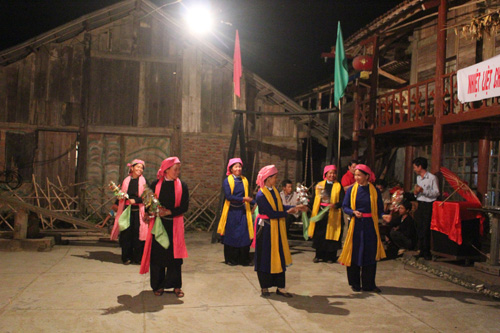 Tourists home-stay in Ta Van Giay hamlet enjoying local songs and dance |
The Giay think a house backing against a mountain will be protected by the mountain genie. If the house looks out on a spacious area, the owner will enjoy business prosperity. Villager Hoang Van Lu said: “We choose the house’s orientation based on the owner’s age. On the construction day, family members whose ages are not compatible with the date of the construction day, must stay away from the site until they’ve finished building it.”
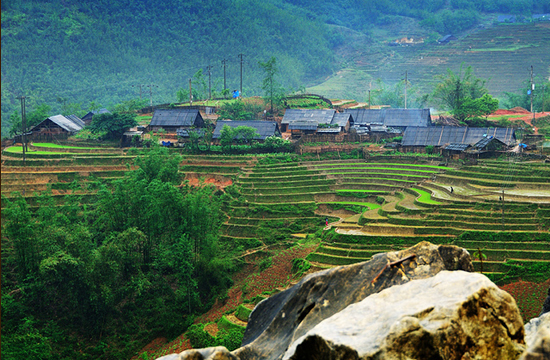 |
| The Giay's houses are near to a water source and their fields |
The Giay use wood or bamboo to build a house, depending on the family’s wealth. They split bamboo trees, weave them to make panels, and apply a mixture of clay and straw to make walls. San Chang again: “The trees must be intact, for example, the tops of the trees were not struck by lightning and had no crow’s nest. We use any kind of tree.”
A Giay house is approximately 1.8 m high and 9 or 10 m wide and is divided into three rooms. Hoang Van Lu explains: “4 main pillars divide the house into three spaces. A garret is built in the front space. The elders live in the central space.”
The middle space is considered the most sacred part of the house, and is where the family’s ancestral altar is located. Family members often gather in this room during festivals and important anniversaries to worship their ancestors. It’s one of the Giay ethnic people’s customs that Giay women are not allowed to sleep in this chamber. Chang said: “An attic is a necessary part of a traditional Giay house. Here they store everything from household utensils to food. The attic also serves as a guest room.”
If a family has more than one daughter in-law, the eldest sleeps in the west room while the younger ones sleep in the east room. In the past, the kitchen was built inside the main house but today kitchens are usually built beside the house. San Chang explains: “The eldest daughter in-law’s room should be close to the kitchen as she has to wake up earlier to prepare breakfast for the whole family. Older family members, who get up later, sleep in rooms further from the kitchen.”
Traditional Giay houses have 3 doors: an entrance door into the middle chamber, another door into the kitchen, and a 3rd door leading to the backyard. San Chang elaborates: “The reason we need a door to the kitchen is because there are things forbidden to pass through the entrance door. For example, we don’t carry fresh meat through the main entrance, and a woman who just gave birth to a child should not pass through the main entrance if the ancestors have not been informed of the child through a ritual ceremony.”
Colorful cloth balls are often hung in front of the main entrance of a Giay house - another unique tradition being preserved by the Giay for their younger generations.
