



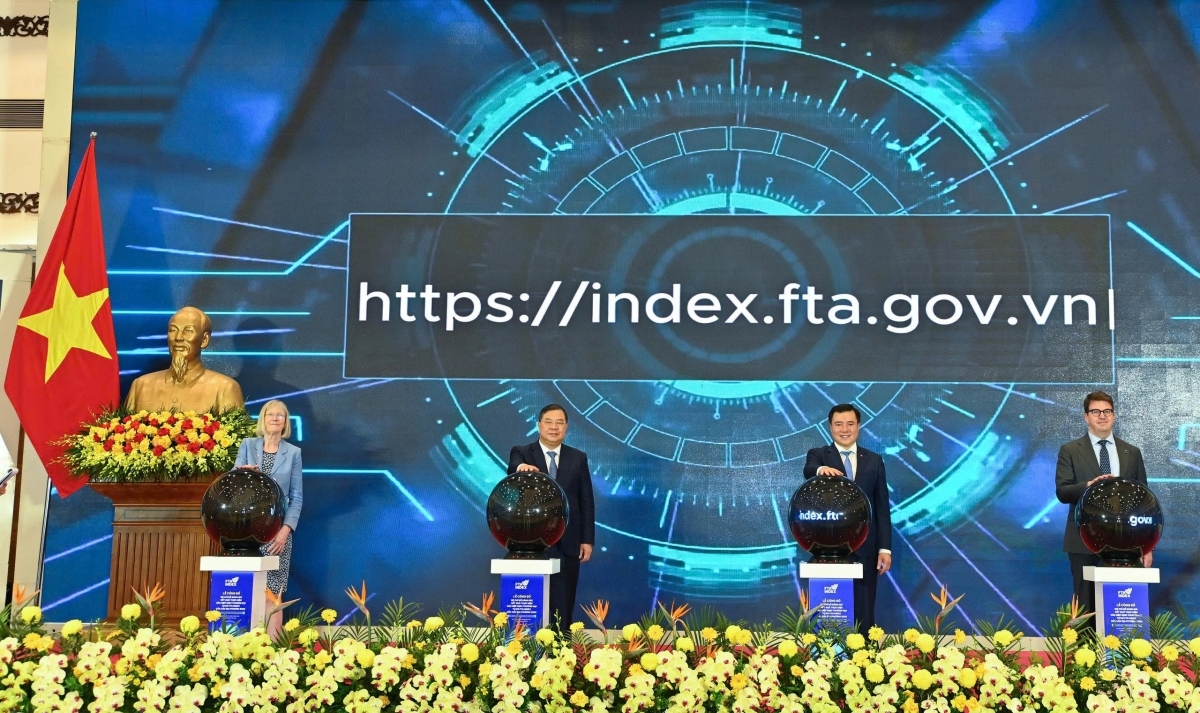
The Ministry of Industry and Trade reported a national average score of 21.66 out of 40 points in the 2025 FTA Index, which assesses local implementation of free trade agreements in Vietnam’s 34 provinces and cities. Hai Phong ranked first with 35.6 points, followed by Tuyen Quang with 33.6 points, then Thanh Hoa, Vinh Long, and Ca Mau.
Hai Phong ranked first in Access to Information with 9.85 points, and Implementation of FTA-related Legal Regulations with 9.4 points. Lai Chau led in Policies Supporting Businesses in Taking Advantage of FTAs with 7.59 points. Ca Mau topped the Sustainable Development category with 9.29 points.
These differences show that the effectiveness of FTAs depends not only on what is committed, but on the capacity to implement those commitments at the local level.
Deputy Minister of Industry and Trade Nguyen Sinh Nhat Tan said: “The data shows that the advantages offered by free trade agreements do not automatically translate into growth without the capacity to implement and effective coordination among the central government, local authorities, and businesses. After the first year of implementation, the FTA Index has introduced a new approach to FTA implementation. Many localities have reviewed their action plans, strengthened dialogue with businesses, improved the quality and provision of information, supported businesses in taking advantage of FTA commitments, and paid greater attention to outcomes.”
Hai Phong is an example of linking FTA implementation with development needs. In 2025, the city recorded GRDP growth of 11.81% and total import-export turnover of 91.72 billion USD, affirming its role as a gateway for import and export and a logistics hub in northern Vietnam.
Vice Chairman of the Hai Phong People’s Committee Hoang Minh Cuong said: “The FTA Index allows the city to assess the efficiency of the entire system, particularly from the perspective of businesses. This helps the city identify what it needs to do better to provide information, support businesses, and make better use of free trade agreements.”
As FTAs become increasingly linked to green standards, rules of origin, traceability, and stringent quality requirements, local authorities need to create an environment for businesses to strengthen their capabilities and move further up the value chain. When integration commitments are translated into concrete action at the local level, FTAs become a driving force for economic growth and competitiveness.