



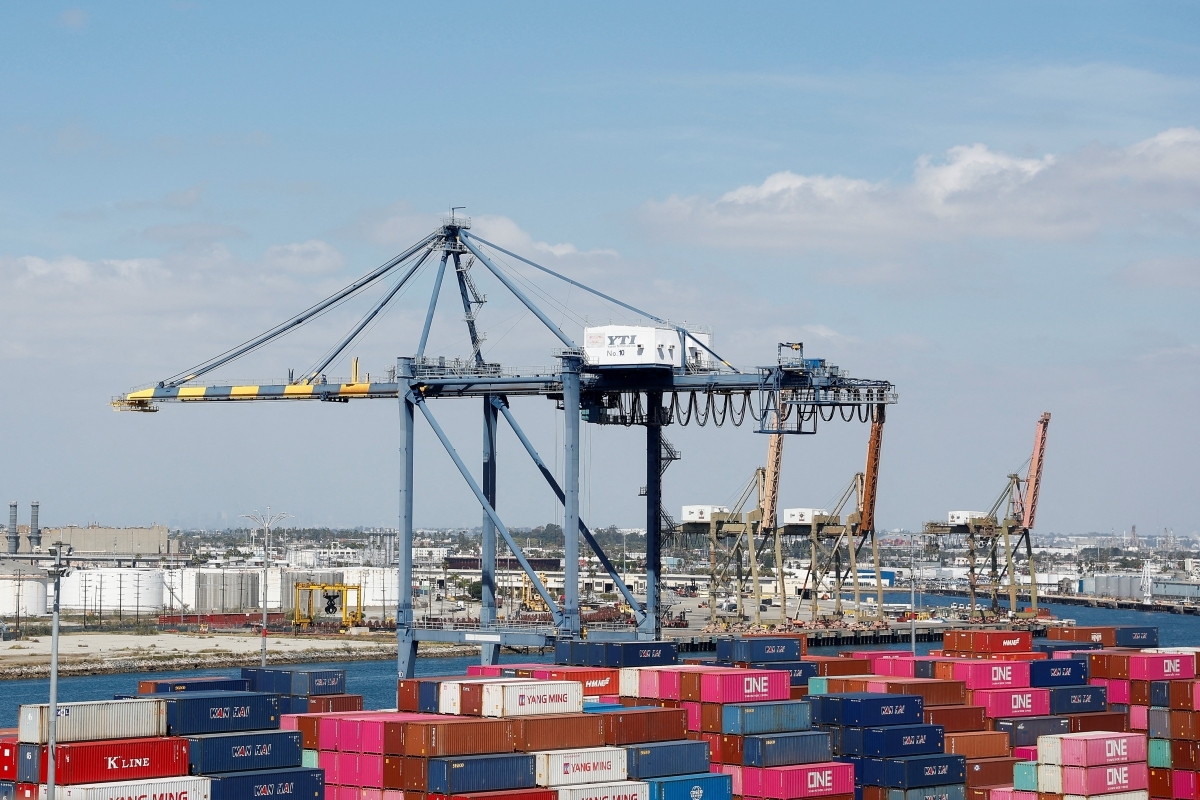
The “Liberation Day” reciprocal tariffs, ranging from 10% to 50%, have caused prolonged trade tensions between the US and many of the world’s major economies despite some temporary adjustments.
Gains and losses for US economy
On February 20, 2026, nearly one year after President Trump introduced the reciprocal tariffs under the International Emergency Economic Powers Act of 1977 (IEEPA), the US Supreme Court struck them down. Hours later, President Trump moved swiftly to introduce a new additional import tariff of 10% for 150 days under Section 122 of the Trade Act of 1974. Tariffs were charged throughout 2025, with adjustments based on new trade deals with specific partners.
Some US officials have praised Trump’s tariff policy, saying it creates a more resilient, competitive, and secure American economy. The US goods trade deficit fell 24% between April 2025 and February 2026. The US goods trade deficits with China and the European Union fell 32% and 40%, respectively. Bilateral trade balances with 63% of the US’s trade partners have improved. The Trump administration has secured at least 20 new trade deals and promises of trillions of dollars in future investment.
But not all indicators have been positive. Growth in 2025 was 2.1%, down from 2.8% in 2024, the year that President Trump called the American economy “dead”. Job growth has slowed from 1.2% in 2024 to 0.5%.
Despite the investment promises Trump demanded from trade partners, foreign direct investment (FDI) growth in the US shrank from 2.7% in 2024 to 1.2% in 2025, and domestic investment growth slowed from 3% to 2%. Trump’s promised grand-scale reshoring of manufacturing has yet to materialize.
William George, Director of Research at Import Genius, said, “With the trade policy having been as uncertain and mercurial as it has been, companies have been somewhat disincentivized to commit too heavily to moving manufacturing because that's a very significant multi-year high dollar investment.”
US imports in 2025 were 4% higher than in 2024, reaching 3.4 trillion USD, largely due to front-loading by companies before the tariffs kicked in. The goods deficit rose 2% to 1.24 trillion USD. Higher tariffs means higher costs for consumers. In August 2025, the Federal Reserve reported that consumers bore 94% of tariff costs, which eased to 86% by year-end. A report from Yale's Budget Lab showed food prices had risen 2.9% year-on-year, and the average US household faced an additional 1,500 USD in annual food costs.
How global economies are adapting
Global trade disruptions caused by US tariffs have prompted economies to diversify partners and reposition themselves in global supply chains. Economist David Hebert of the American Institute for Economic Research (AIER) said countries are lowering trade barriers and strengthening cooperation to offset losses in the US market. The world is not deglobalizing but “re-globalizing” around rule-abiding partners to replace partners using tariffs as coercive tools.

Kari Heerman, Director of Trade and Economic Statecraft at the Brookings Institution, said that most US partners prefer negotiation of mutually acceptable agreements, and US trade policy will push them to reduce dependence on the American market in the long-term.
“Globally, we didn't see mass global countermeasures. We didn't start a global trade war with Liberation Day and the rest of the actions during this year, but we have seen our trading partners very deliberately in some large and small, loud and quiet ways, try to adjust the way that they interact economically with the United States to draw closer to each other and further from the United States,” said Heerman.
How will global trade evolve?
The current conflict in the Middle East is overshadowing trade talks. But, in addition to the temporary 150-day 10% tariff applied in February, the US administration is seeking new legal means, including trade investigations, to prolong last year’s tariff measures.
Professor of Law and Economics at Georgetown University, David Super, said, “I think it's going to be a choice that those countries are going to have to make. The tariffs President Trump instituted last year, despite being completely illegal, stayed in place for most of a year. If a country tears up their agreement with him, he will probably impose illegal tariffs on them again, which will eventually be struck down, but some countries don't want to wait for that, particularly if we go into a global downturn.”
Some economists believe that if the Middle East conflict persists, keeping energy prices high and slowing economic growth, the US and its partners will not be able to maintain the current tariff levels and will need to adopt more flexible trade policies.