(VOVWORLD) - The Hanoi People's Council recently approved a landmark resolution endorsing the capital’s master plan and its 100-year vision for shaping the city’s spatial development.
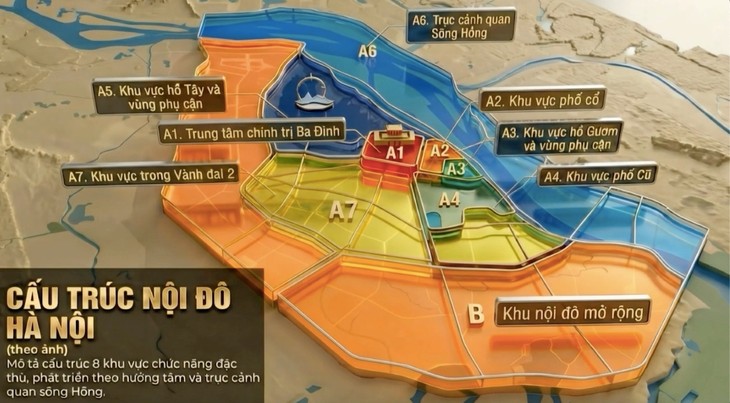 The urban structure orientation for Hanoi’s inner city under the Capital Master Plan with a 100-year vision (Photo: Hanoi People’s Committee) The urban structure orientation for Hanoi’s inner city under the Capital Master Plan with a 100-year vision (Photo: Hanoi People’s Committee) |
Hanoi's spatial and urban infrastructure development will preserve cultural and historical heritages while re-landscaping the margins of the Da, Hong, and Duong rivers. The capital’s development model is restructured as a multi-polar, multi-center urban system integrated with a multi-layered urban structure. The goal is to distribute population, production and service zones, and infrastructure more evenly to ease pressure on the current urban center.
Architect Ngo Trung Hai, Vice President of the Vietnam Association for Urban Planning and Development, said, “The resolution integrates capital planning and the general construction plan of Hanoi into a single framework with a unified long-term vision. I hope this master plan will position Hanoi among the world’s major mega cities. We must firmly secure Hanoi’s place on that map.”
The 100-year master plan seeks to make Hanoi not only the nation’s political and administrative center, but also a pole generating double-digit growth over the long term with a vision extending well beyond the next century.
The ambition is for Hanoi to assume the stature of the capital of a high-income socialist-oriented country, while serving as a development engine for the Red River Delta, the capital region, the northern key economic zone, and the country as a whole.
According to Nguyen Duy Ngoc, Secretary of the Hanoi Party Committee, “The master plan shapes the long-term stature, identity, and socio-economic structure of the capital in relation to the northern region, the nation, and the international community.”
“Institutions, centered on the Politburo's Resolution and the Law on the Capital, provide a political and legal basis for removing bottlenecks in mechanisms and policies, creating strong frameworks, and turning plans into sustainable development,” Ngoc added.
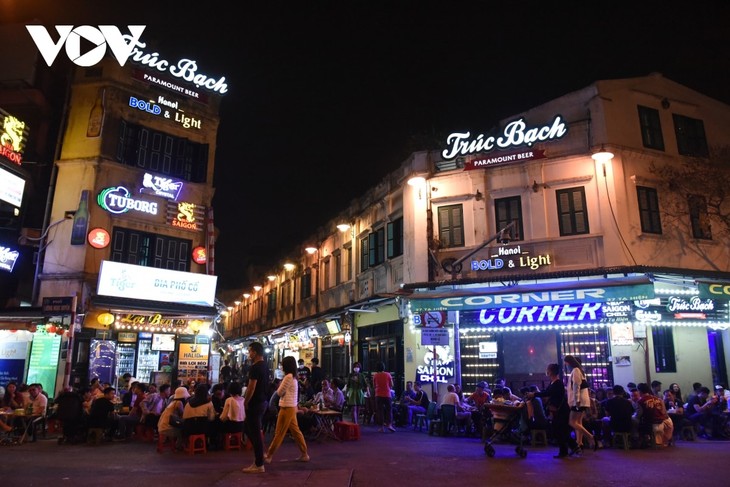 In the heart of Hanoi’s Old Quarter, the Ta Hien-Luong Ngoc Quyen food corner buzzes with local and international visitors. In the heart of Hanoi’s Old Quarter, the Ta Hien-Luong Ngoc Quyen food corner buzzes with local and international visitors. |
The future structure of the Hanoi region will follow a “centripetal urban cluster” model that has 9 growth poles, 9 centers, and 9 urban and economic corridors along major transportation arteries. Conservation and restoration priorities include the Ba Dinh political-administrative center, the Hoan Kiem Lake area, the Old Quarter, West Lake, and both banks of the Red River.
Architect Hai said that the most notable feature is the development of 10 urban railway lines, realizing breakthroughs envisioned in earlier plans. Public transport and high-speed rail connections will link residents to satellite cities, new growth poles, and nine development corridors under the new resolution.
“The success of these new centers will depend largely on whether Hanoi can build 10 or more urban railway lines. In my opinion, this is the biggest breakthrough planned for the next decade. I believe restructuring will succeed because commuting will become far more convenient for residents,” Hai noted.
Hanoi also has a roadmap for population redistribution and zoning within the inner city. Some residents in clearance and relocation areas will receive on-site resettlement, while others will move to new urban areas near growth poles like Dong Anh, Gia Lam, and Hoa Lac, where infrastructure and public services will be well developed.
Between 2026 and 2035, Hanoi plans to relocate approximately 442,000 residents, mainly from areas along the Red River, West Lake, and several central streets. Between 2036 and 2045, another 420,000 residents from downtown areas will be relocated. In total, more than 860,000 people are expected to be relocated by 2045 as part of urban restructuring toward a greener, smarter, more sustainable capital.
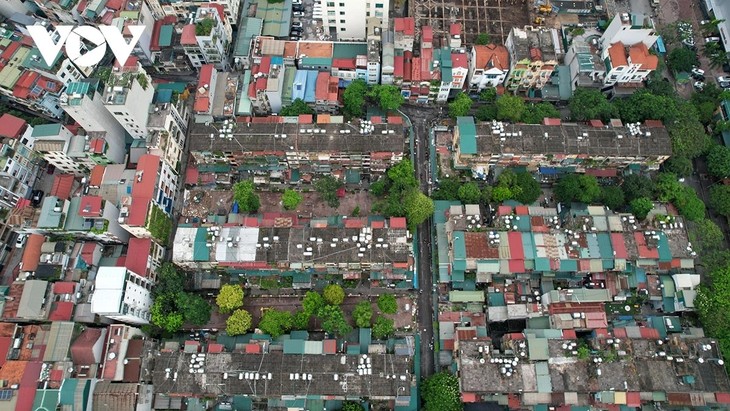 The Vinh Ho apartment complex as seen from above The Vinh Ho apartment complex as seen from above |
Architect Hai suggested that Hanoi develop its outskirts by forming high-quality new cities with strong infrastructure, creating jobs and ensuring connectivity with the inner city.
“Once transport connectivity improves, residents will naturally move outward in search of better living environments and employment opportunities while still commuting conveniently to the core. Only then can the multi-polar, multi-center model succeed while preserving the historic heart of the city,” Hai said.
Under the master plan, Hanoi’s administrative area will have 126 commune-level units, consisting of 51 wards and 75 communes, covering more than 3,300 square kilometers.
Looking toward 2100, Hanoi aims to reconstruct the inner city while preserving the soul of Thang Long-Hanoi and opening new development spaces. The principal challenge will be turning this long-term vision into action through a strong legal framework, effective resource mobilization, and transparent implementation that protects citizens’ legitimate rights. The plan is an urban revolution that could elevate Hanoi into the ranks of the world’s leading cities.