



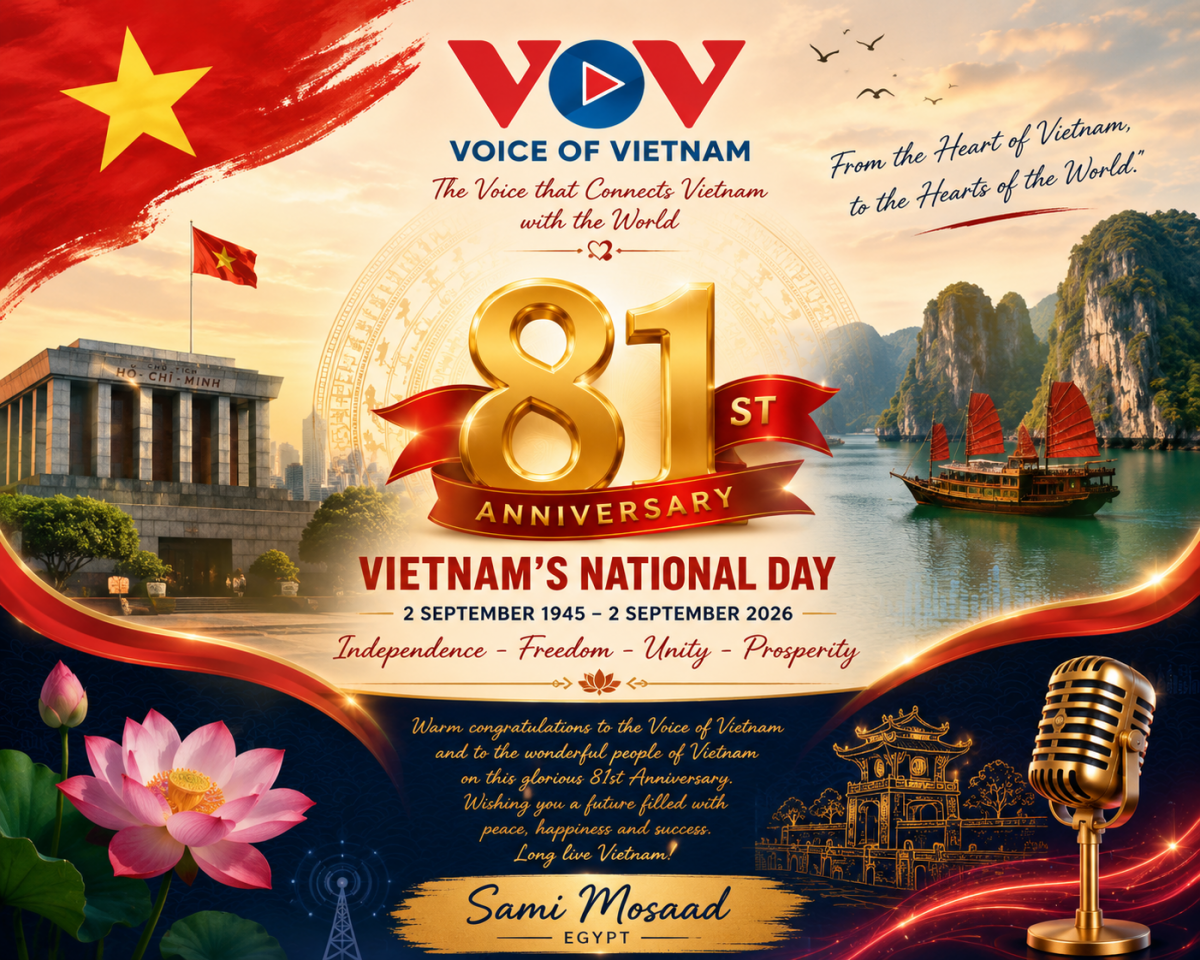
B: Gerry Neumann of England said: “I'm sure you are all looking forward to the above date, as it's the 81st anniversary of the start of VOV's broadcasting in 1945. In that time VOV has gone from strength to strength whilst many other international short wave broadcasters have come and gone. I've only been a regular listener for the last 25 years, but can honestly say how much the daily broadcasts mean to me, and I have fond memories of my visits to 45 Ba Trieu to meet some of the staff of VOV. I send you my sincere congratulations, and look forward to the success of VOV in the future.”
B: Mr. Neumann, we still remember your last visit to VOV in June 2016, when you came to Vietnam as a volunteer English teacher for a summer program in Hue City. Before leaving Hanoi for Hue, you visited our office, and we enjoyed a lunch of bun cha (grilled pork with vermicelli) at a local restaurant. It was such a lovely get-together and we have fond memories of that day.
A: It’s been 10 years already! Time really flies. We’re very happy that you’ve continued to stay in touch with us through our programmes.
B: Here we have warm greetings from Ashik Eqbal Tokon, a member of VOV Spectators’ Association of Bangladesh. He said: “As September 7 approaches, I feel truly delighted and honored to extend my heartfelt congratulations and very best wishes to Voice of Vietnam on its 81st broadcasting anniversary.”
A: Thank you, Mr. Tokon, for your thoughtful message and for taking the time to design such a lovely e-greeting card for VOV. We’ll post it on our website, so everyone can enjoy it.
A: Abid Hussain Sajid, a DXer from Pakistan, shared a wonderful story about his long-standing connection with VOV. He recently came across a message and certificate from us recognizing a listener for 20 years of loyalty, which brought back memories of a QSL card we had sent him in 1990 — 36 years ago!
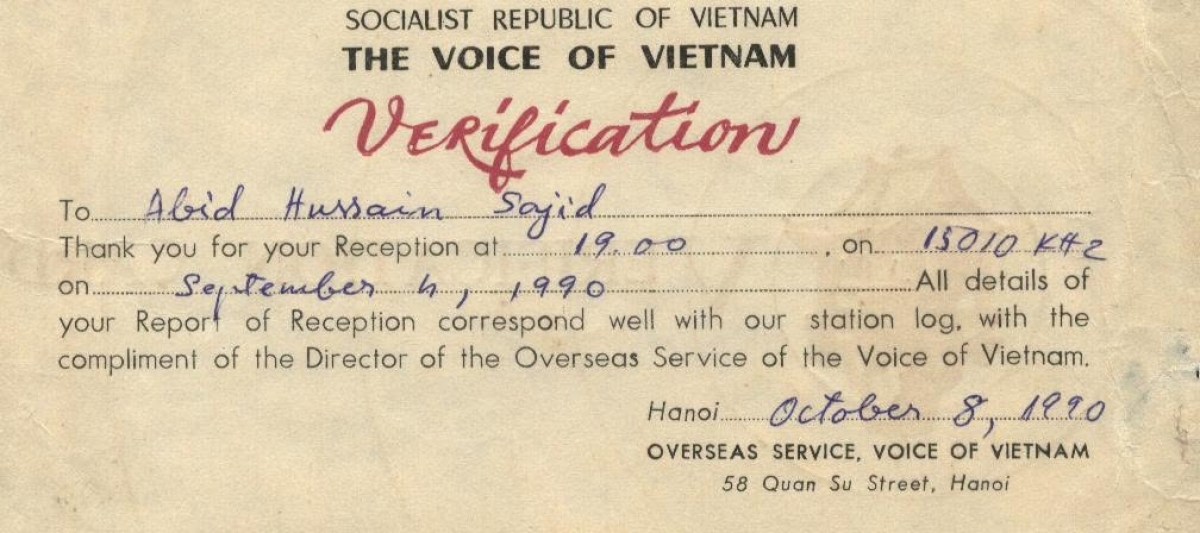
B: 36 years, that’s a remarkable connection. Mr. Sajid says that a lot has changed during those years. He has gone from being a student to a teacher, and now, at the age of 60, he’s preparing to retire. But one thing that hasn’t changed is his connection with VOV.
A: This QSL card was issued on October 8, 1990. More than three decades later, he still keeps it with great care and remains a loyal listener of our station.
B: Mr. Sajid, we’re grateful that you’ve stayed with VOV for such a long time and shared such a meaningful memory with us. We hope our friendship will continue for many more years.
A: I’m reading an email from another Pakistani listener, Malik Allah Bachaya. He tuned in to VOV’s English program on August 18 on the frequency of 11885 kHz, using a digital radio receiver connected to a long-wire antenna.
A: Mr. Bachaya noted: “The reception was excellent. The station's signal was strong and clear, making it easy to listen to the complete broadcast. The recorded SINPO rating of 55544 reflects the good overall reception conditions. Only a small amount of interference or atmospheric disturbance was noticed, and it did not seriously affect the listening experience.”
B: Mr. Bachaya appreciates VOV’s diverse topics which are useful for foreigners to learn more about Vietnam, its people, culture, society, development, and current affairs.
A: He goes on to say: “The broadcast demonstrated the continuing importance of international shortwave radio. A station such as Voice of Vietnam can reach listeners across borders without depending on local internet services or other modern communication platforms. For radio enthusiasts and shortwave listeners in Pakistan, international broadcasts provide an interesting opportunity to hear programs from distant countries and to learn about their cultures and viewpoints.”
B: We’re glad to know that VOV continues to be a useful source of information for you and many other shortwave listeners. Thank you for sharing your listening experience and for your thoughtful comments on our programmes.
A: And now, as a small token of our appreciation for your continued support, we’d like to dedicate a song to all our listeners around the world. Singer Thuy Chi performs “Hanoi’s Twelve Flower Seasons”, written by Giang Son. We hope you enjoy it.
B: And after the music, we’ll answer a question from Chris Malboeuf in Canada, who is interested in art museums in Vietnam. So, stay with us!
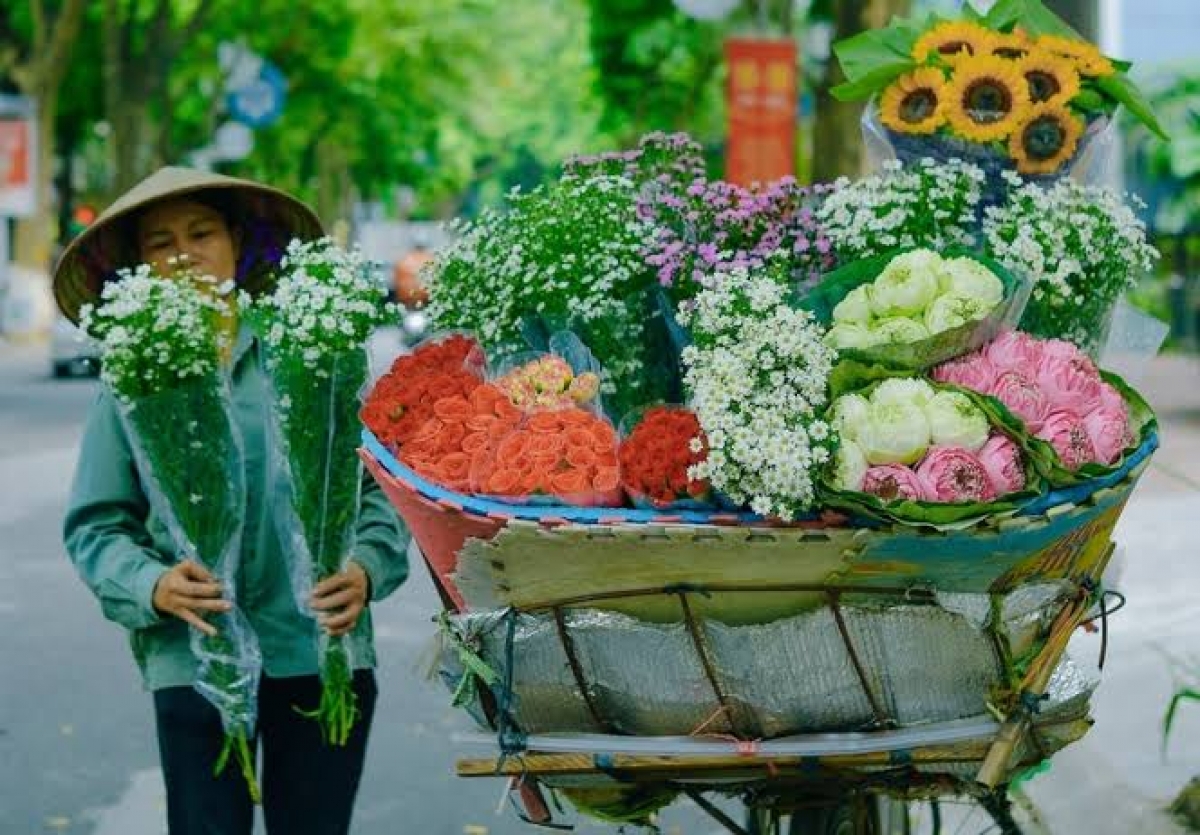
A: That was “Hanoi’s Twelve Flower Seasons” performed by Thuy Chi. The song celebrates Hanoi through its changing seasons and the different flowers that bloom throughout the year, painting a gentle and romantic picture of the capital.
B: Chris Malboeuf from Canada asks: “What types of art museums are there in Vietnam for people to visit?”
A: If you’re interested in art, Mr. Malboeuf, you’re in luck. Vietnam has a variety of art museums, from museums dedicated to traditional and fine arts to those focusing on certain ethnic groups’ art and culture and contemporary art.
B: The Vietnam National Fine Arts Museum in Hanoi is a great place to start. It houses around 20,000 objects and artworks, representing Vietnamese art from prehistoric times to the present, including paintings, sculptures, ceramics, lacquerware and other forms of traditional and modern art.
A: The museum preserves nine national treasures, including ancient Buddhist sculptures and some of the most iconic paintings of modern Vietnamese art. Among the treasures are two ancient wooden sculptures. One is the Goddess of Mercy, dating from the 16th century. It is the oldest of the nine treasures and stands more than three metres tall. The other is the statue of Queen Trinh Thi Ngoc Truc, dating from the early 17th century.
B: The third treasure ranked by time is a pair of wooden doors with carved dragons from Keo Pagoda in Hung Yen province dating from the 17th century, a fine example of traditional Vietnamese wood carving.
A: Meanwhile, the treasure paintings representing modern Vietnamese art include “Little Thuy” by Tran Van Can, “Two Girls and a Child” by To Ngoc Van, and “Party Admission Ceremony in Dien Bien Phu” by Nguyen Sang.
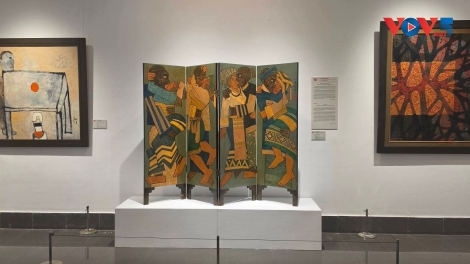
B: Others are “Uncle Ho in the Viet Bac War Zone”, a lacquer painting by Dương Bich Lien; “Standing Screen”, an eight-panel lacquer work by Nguyen Gia Tri; and “Saint Giong”, a lacquer painting by Nguyen Tu Nghiem.
A: These works are particularly valuable for both their artistic quality and their historical and cultural significance.
B: Further south, the Ho Chi Minh City Museum of Fine Arts is a major destination. Its collections include ancient sculptures, ceramics, lacquerware, traditional woodblock prints, and modern and contemporary Vietnamese art.
A: It houses two national treasures. One is “Spring Garden in Central, Southern, and Northern Vietnam”, a large-scale lacquer painting by Nguyen Gia Tri that took him about 20 years to complete. The other is “Youth of the Iron Fortress” by Nguyen Sang, which depicts student and youth protests in Saigon (now Ho Chi Minh City) during the war.
B: There are also numerous private contemporary art spaces and galleries, particularly in Hanoi and Ho Chi Minh City, so Mr. Malboeuf, whether you’re interested in traditional Vietnamese art, ancient sculpture, modern painting or contemporary art, there are plenty of places to explore. We hope you’ll have a chance to visit some of them on your next trip to Vietnam!
A: Next, we acknowledge a reception report from Seiji Hattori, who monitored VOV’s English broadcasts from August 12 to 20. We’re pleased to learn that you were able to receive our programmes on 11885 kHz under generally stable conditions, with signal strength averaging around SINPO 3 to 4. Our technical team will appreciate your comments about the occasional interference, especially from NHK World Radio Japan after 21:55, which affected the final few minutes of the broadcast.
B: Your detailed observations are very useful to us, Mr. Hattori. We’ll be happy to verify your report with our QSL card.
A: I’m reading an email from Chinmoy Mahato, President of the Guide International Radio Listeners Club in India. Mr. Mahato says he listened to our Letter Box program on August 19 and enjoyed hearing the views and messages of listeners from around the world.
B: Mr. Mahato, thank you so much for your feedback. The photo of you sending a letter to us at the local post office will definitely be posted on our website.
A: That’s all for this week’s Letter Box. Thank you for your continued support and for being part of the VOV family. Please keep your letters and reception reports coming.