






 |
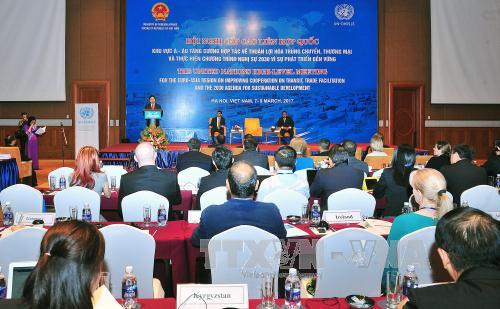
| The meeting discussed measures to support non-maritime countries access international seaports (Photo: Nguyen Khanh/VNA) |
The meeting is attended by 200 representatives from 40 countries and 29 international organizations. They discussed specific measures to strengthen connectivity and trade facilitation, including cooperation between non-maritime and transit countries to attain sustainable development goals.
Boosting the 2030 Agenda through trade liberalization
The Vienna Program of Action for Landlocked Developing Countries, the 2030 Agenda for Sustainable Development, and the Addis Ababa Action Plan affirmed that trade is a decisive factor in carrying out the 2030 Agenda for Sustainable Development and acknowledged challenges and special demands of non-maritime countries. The Agenda also set priorities to support non-maritime and transit countries to integrate into regional value chains so no country will be left behind in the 21st century.
UN Deputy Secretary General Gyan Chandra Acharya said: "The 2030 Agenda for sustainable development acknowledges special needs and challenges faced by the non-maritime countries. There is a need for the international community to support development effort of these countries. We should focus on cooperation in order to improve the physical infrastructure, the harmonization of customs procedures and standards, the consistency and harmonization of policy."
With its 30 years experience in renewal and global integration, Vietnam is fully aware of the importance of trade and investment facilitation to economic development and poverty reduction. Vietnam has participated in multilateral mechanisms like the WTO, ASEAN, APEC, ASEM, and free trade agreements with many partners. Vietnam has connected its infrastructure with Laos, a non-maritime country, to boost economic cooperation as Deputy Prime Minister and Foreign Minister Pham Binh Minh puts it: “Vietnam gives priority to enhancing cooperation with neighboring countries. We believe that the success and prosperity of our neighbors will benefit Vietnam’s growth and sustainable development. Vietnam has enhanced economic cooperation and infrastructure connectivity with its neighbors, particularly those in the lower Mekong region, to establish an economic corridor and link remote countries with international seaports.”
Vietnam continues to actively participate in UN efforts
Vietnam has proposed to mobilize resources from international financial organizations and the private sector in building transit point infrastructure.
