







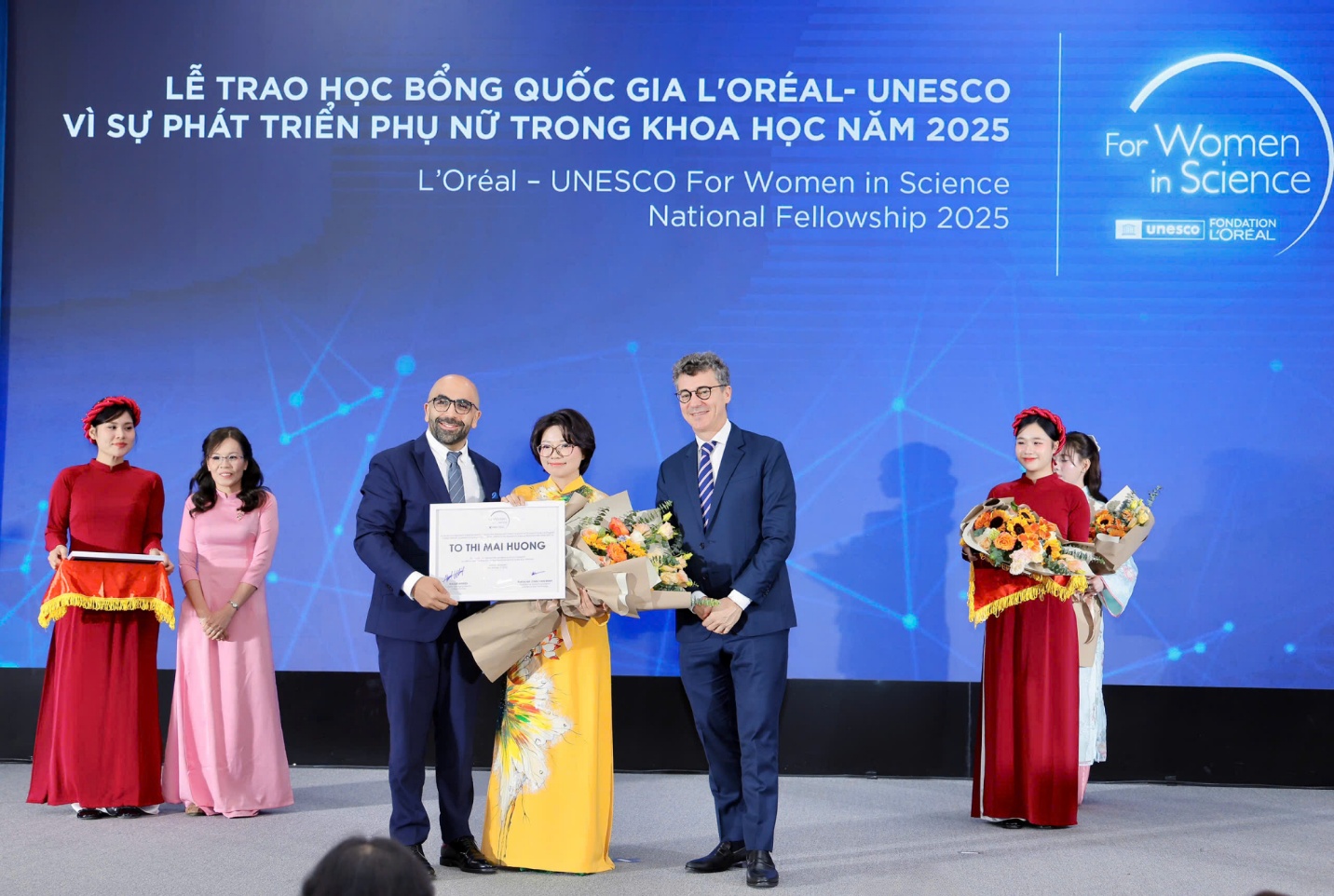
 Wagih Ahmed, Chief Executive Officer of L’Oréal Vietnam, and Jonathan Wallace Baker, UNESCO Representative to Vietnam, present the L’Oréal–UNESCO For Women in Science Award for Assoc. Prof. Dr. To Thi Mai Huong. (Photo: mst.gov.vn) Wagih Ahmed, Chief Executive Officer of L’Oréal Vietnam, and Jonathan Wallace Baker, UNESCO Representative to Vietnam, present the L’Oréal–UNESCO For Women in Science Award for Assoc. Prof. Dr. To Thi Mai Huong. (Photo: mst.gov.vn) |
The three recipients are Associate Professor Dr. To Thi Mai Huong, Deputy Head of the Research, Innovation and International Cooperation Department and Head of the Executive Board of the Innovation and Startup Center of Hanoi University of Science and Technology; Associate Professor Dr. Pham Kim Ngoc, Head of the Department of Nano Materials and Thin Films, Faculty of Materials Science and Technology, University of Science, Vietnam National University HCM City; and Dr. Le Linh, Postdoctoral Researcher at Stanford University in the US.
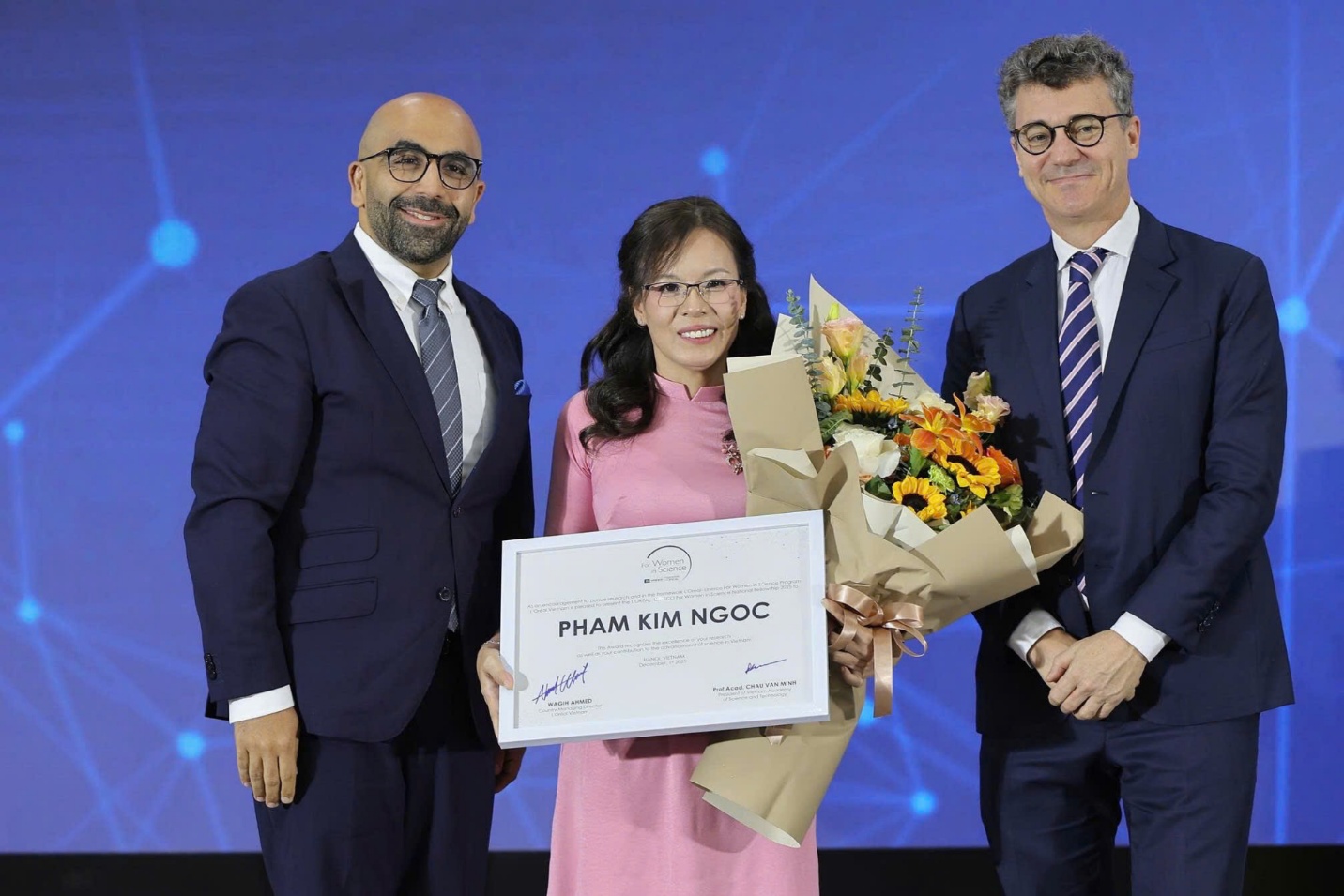 Wagih Ahmed, Chief Executive Officer of L’Oréal Vietnam, and Jonathan Wallace Baker, UNESCO Representative to Vietnam, present the L’Oréal–UNESCO For Women in Science Award for Assoc. Prof. Dr. Pham Kim Ngoc. (Photo: mst.gov.vn) Wagih Ahmed, Chief Executive Officer of L’Oréal Vietnam, and Jonathan Wallace Baker, UNESCO Representative to Vietnam, present the L’Oréal–UNESCO For Women in Science Award for Assoc. Prof. Dr. Pham Kim Ngoc. (Photo: mst.gov.vn) |
Addressing the National Fellowship 2025 Ceremony in Hanoi on Monday, Dr. To Thi Mai Huong said that the award is a timely source of encouragement.
“We are truly moved to receive it because, of all the efforts made by scientists in general, as female scientists, we encounter multiple difficulties which relate to the various roles we must undertake,” said Huong, adding, “ It’s a great honor for us to be recognized by a prestigious organization like L'Oréal-UNESCO, and it’s also an encouragement for other female scientists to have more faith in the path they have chosen, to feel motivated, and to see that their research holds meaning for society."
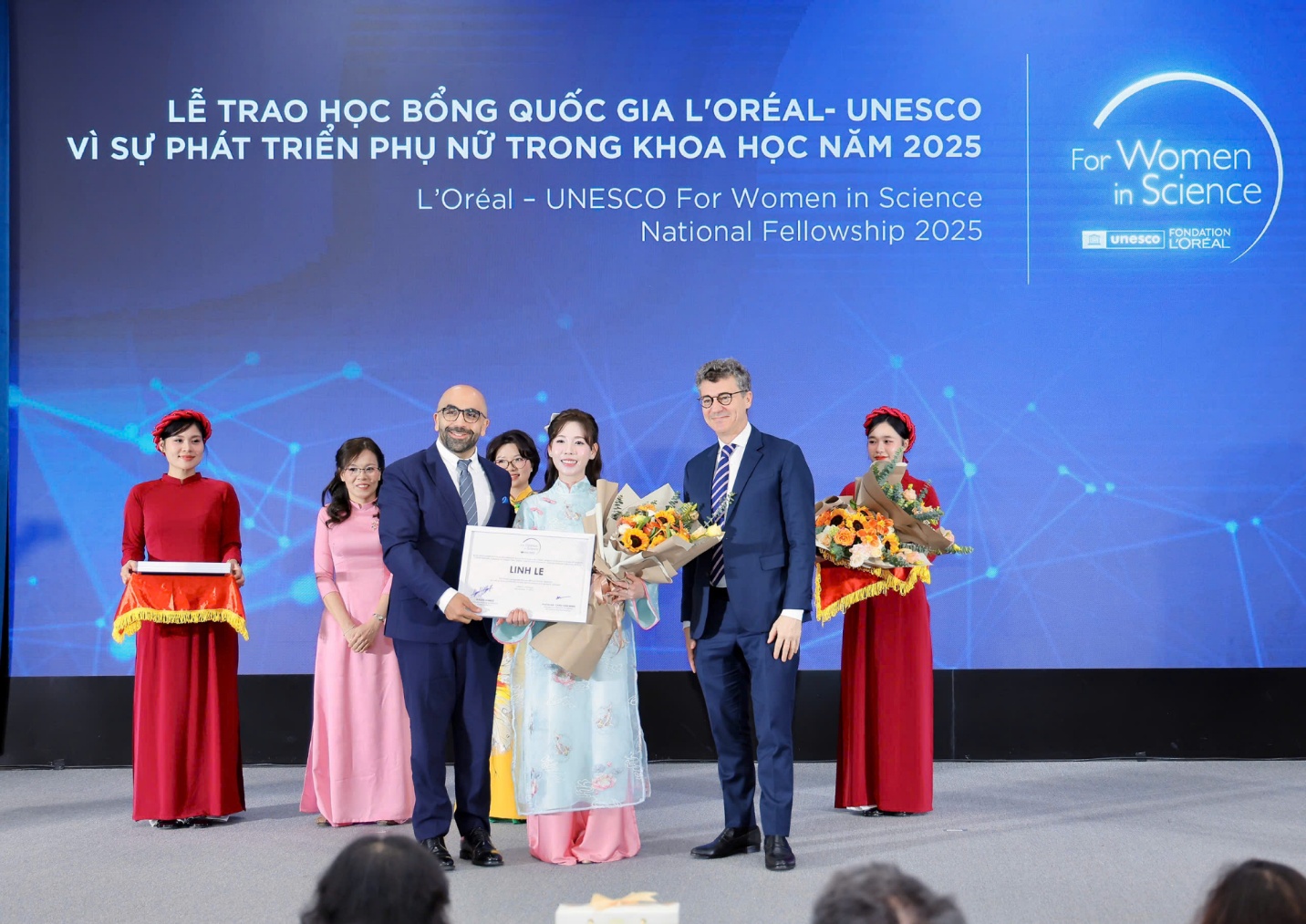 Wagih Ahmed, Chief Executive Officer of L’Oréal Vietnam, and Jonathan Wallace Baker, UNESCO Representative to Vietnam, present the L’Oréal–UNESCO For Women in Science Award for Dr. Le Linh. (Photo: mst.gov.vn) Wagih Ahmed, Chief Executive Officer of L’Oréal Vietnam, and Jonathan Wallace Baker, UNESCO Representative to Vietnam, present the L’Oréal–UNESCO For Women in Science Award for Dr. Le Linh. (Photo: mst.gov.vn) |
-Assoc. Prof., Dr. To Thi Mai Huong has used precise gene editing technology to increase the expression of certain genes by inserting short transcriptional enhancers. The goal is to optimize carbon allocation in rice plants and reduce root exudates. This is an important step toward creating better rice varieties that have high yields but are light on greenhouse gases.
-Assoc. Prof., Dr. Pham Kim Ngoc focuses on In-Memory Computing architectures to overcome the traditional von Neumann bottleneck. By developing memristors — devices capable of storing analog states that mimic synaptic behavior — particularly self-rectifying memristors, her research spans materials, devices, and integrated circuits.
-Dr. Le Linh advances promising research on Lithium–Sulfur (Li–S) batteries. Her project designs multifunctional liquid electrolytes that combine co-solvents and additives to minimize polysulfide shuttling and stabilize lithium metal, thereby improving capacity and durability.
