







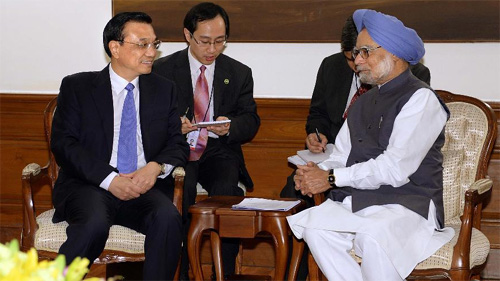
 Indian Prime Minister Manmohan Singh (right) hold talks with his Chinese counterpart Li Keqiang (left)in New Delhi (photo: Xinhua News Agency) |
But in fact, speaking is easier than action. Although China is India’s biggest trading partner, India’s trade deficit has increased, one factor amplifying their differences. Trade relations, which started near zero in the 1990s, have developed to the benefit of China. Beijing exports mainly electrical and telecommunications devices to India but has not opened these sectors for India. China has denied that the trade deficit is due to import restrictions, attributing the imbalance to “economic structure differences between the two countries.” Of course, India has not been satisfied with this reason. So, when he agreed to raise two-trade revenues, Singh said frankly that in order to obtain the impressive figure of 100 billion USD in trade revenue by 2015, it will be necessary to balance the trade deficit, which will depend mainly on China.
In addition to the trade deficit, long-standing territorial disputes between India and China have been obstacles to building trust. Distrust between the two sides since their border war in 1962 has continued to smolder. Prior to this visit, relations became acutely strained when India accused the Chinese army of violating its territory in the northwestern Himalayas. India massively mobilized its military forces to this area and tension merely eased when the two sides agreed to seek a long-term and comprehensive solution.
During this visit, territorial disputes were high on the agenda but didn’t gain concrete results. The Chinese leader just proposed a general trust building mechanism on the disputed border, saying that recommendations to reduce tension should be considered for a long run.
Before Li’s visit to New Dehli, the Chinese People’s Daily ran an editorial saying that China and India should agree to separate the border issue from other issues to ensure that differences in that area will not undercut improvements in overall relations.
Analysts say if they set the strategic issue aside and focus on economics, disputes will continue to occur. India has implemented a series of measures to win higher status, such as adjusting its military and diplomatic strategy and modernizing its military. China cannot ignore the danger of a “gigantic neighbor”. Furthermore, India’s close relationship with the US and its failure to support China in East Sea disputes are making Beijing – New Delhi relations rockier. During talks, Indian Prime Minister Singh rejected to support China’s stance on East Sea disputes.
While Li Keqiang’s visit to New Dehli is a gesture of neighborliness, India and China lack mutual trust. Analysts say a breakthrough in their relations is unexpected.
Anh Huyen
