(VOVWORLD) -“History carved in stone” is an ongoing display of documents drawn from the historical and artistic values of the 82 steles recording the names of doctorate laureates at the Special National Monument of the Temple of Literature–Quoc Tu Giam in Hanoi. Using traditional and digital technology solutions, the display offers a refreshing approach to heritage stories.
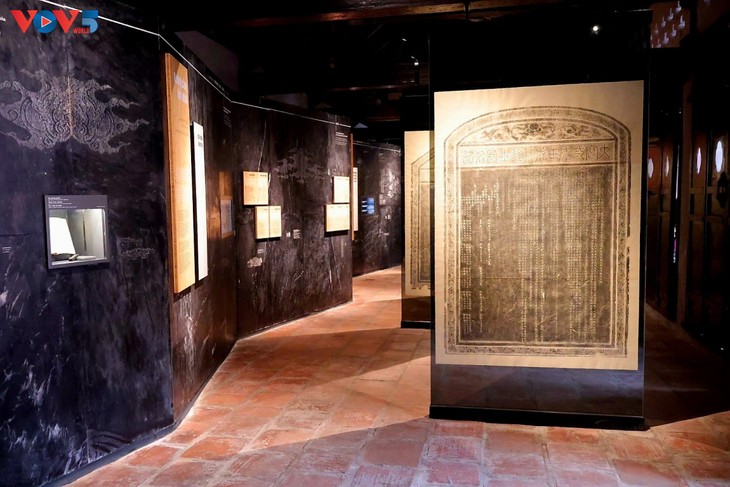 The exhibition “History carved in stone” at the Special National Monument of the Temple of Literature–Quoc Tu Giam in Hanoi (Photo: Thuy Tien/VOV1) The exhibition “History carved in stone” at the Special National Monument of the Temple of Literature–Quoc Tu Giam in Hanoi (Photo: Thuy Tien/VOV1) |
The exhibition provides an overview of the Confucian education system in the feudal period, policies on selecting, rewarding, and valuing successful candidates, and portraying several outstanding historical figures who made significant contributions to Vietnam’s education and many other fields.
Besides traditional display methods, digital technology solutions are applied to recreate both physical and virtual cultural heritage spaces.
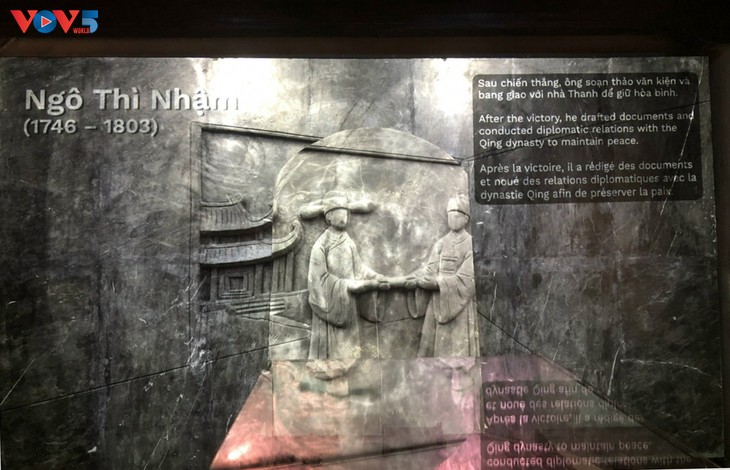 A virtual display at the exhibition (Photo: Thuy Tien/VOV1) A virtual display at the exhibition (Photo: Thuy Tien/VOV1) |
Kim Phuong, from BSM Labs, a company specializing in software development and AI applications in culture and history, said, “When visitors press a button on the keyboard corresponding to a stele, the position of the turtle will light up. Visitors can visualize the exact place of the stele. As the turtle sensor lights up, information about the stele will appear, and visitors can press ‘Play’ to watch a video. All the images are hand-molded from clay and then we use AI and post-production technologies to transform the clay content into animated videos.”
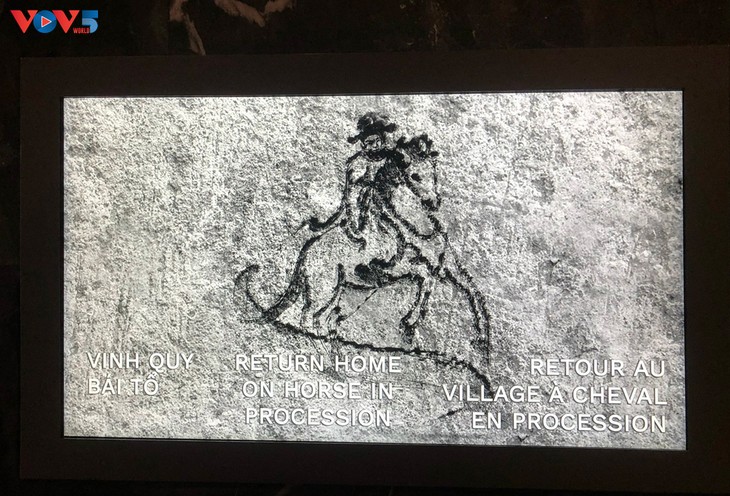 Animated video of a newly awarded doctorate returning home in triumph. (Photo: Thuy Tien/VOV1) Animated video of a newly awarded doctorate returning home in triumph. (Photo: Thuy Tien/VOV1) |
The new exhibition is closely connected with permanent displays such as “Quoc Tu Giam – Vietnam’s first national university” and “Rekindle the learning spirit”, forming a complete heritage space of the Temple of Literature.
Truong Quoc Toan, a member of the exhibition’s content team, said, “The stele inscriptions vary in length: some are very long, some quite short. We tried to extract the common information on 82 stele inscriptions and present it in a systematic way, helping viewers understand the stories behind each doctorate stele. So, they get to know the policies of recruiting and valuing talent in the past, and the examination journey of scholars.”
The exhibition “History carved in stone” refreshes the way heritage stories are told, enabling the public to engage more closely with history and the ancient scholars’ contributions to education.