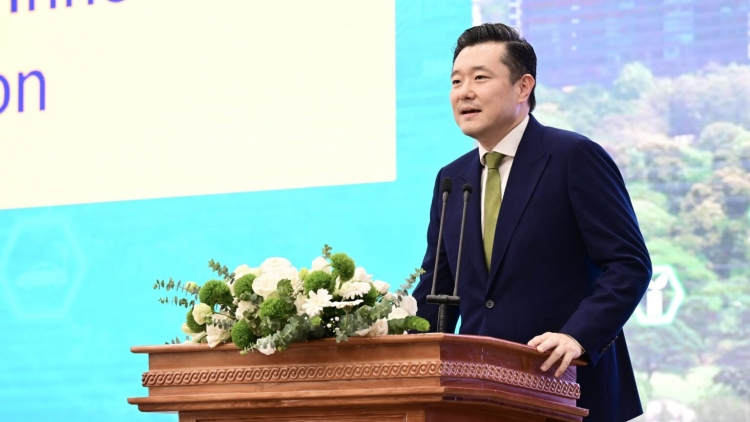




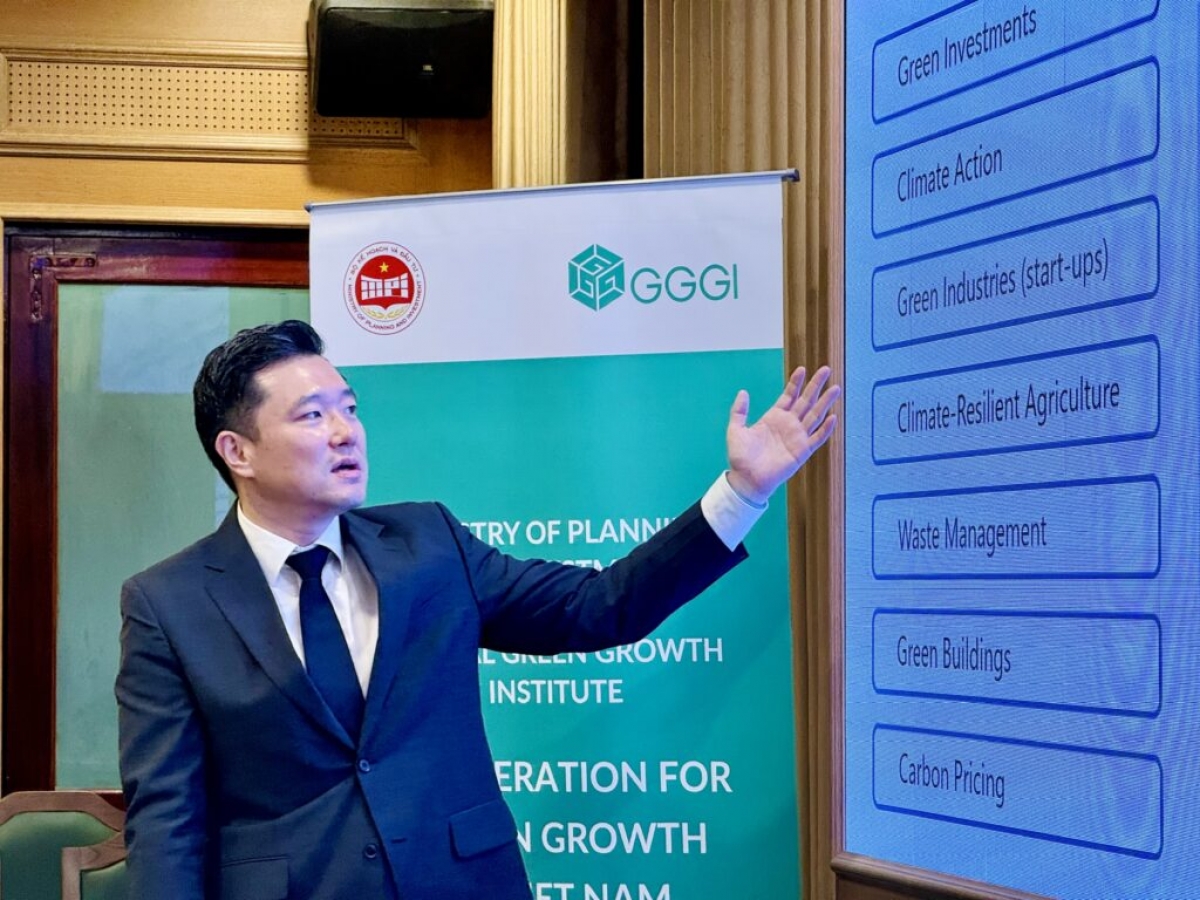
Bao Tram: Thank you, Mr. Kim, for joining VOV24/7. Given the complexities of the current global economy, what is the GGGI’s strategic roadmap for reaching the goal of 1 billion USD in green financing for Vietnam by 2028?
Juhern Kim: Thank you for the question. That's the commitment we made for the period 2024 to 2028 with the government of Vietnam. So far, we’ve mobilized more than 200 million US dollars, one fifth of the target. We do it in two simple ways.
One way is we “green” the finance sector, meaning we work with banks and financial institutions to get them to commit and mobilize money for green projects.
The other angle is we support green projects to be bankable so these financial institutions can invest. But the number 1 billion USD is not the whole story. The more important thing is that we identify good projects, and then help make those green projects investable.
Bao Tram: As you said mobilizing capital is only half the battle; ensuring it reaches the right projects is equally vital. In this case, how does GGGI ensure that green capital is disbursed effectively?
Juhern Kim: The number one priority is to make the project bankable – finding a good potential project, working with the finance institution, and then providing our support for that project to make it bankable. The second thing is making the financial institutions commit to investing in green projects. For example, we're trying to support leading banks in Vietnam to develop green bond or green loan frameworks so they will have their own public commitment to allocating that capital toward green projects. That's another way of doing it. We track their spending record, and then we help them develop so-called impact reports on what kind of green project they actually invest in. Then we publicize it so we will have transparency in terms of them meeting their commitment.
Bao Tram: With the Vietnamese government’s designation of 'hard-to-abate' sectors like steel and cement for the carbon market this year, how do you assess the potential of that mechanism?
Juhern Kim: This is the first year for the carbon market pilot. The government designated three sectors – cement, steel and thermal power – and we called them the “hard-to-abate”sectors. The most important thing is through the carbon market getting those “hard-to-abate”sectors to transition toward net zero as much as they can. Because the carbon market is not the end. It's a way to make the industry green. Through that measure, the cement and steel sectors will think about mid-term and long-term roadmaps and how to green their sectors. That's the most important thing. The second thing is for the carbon market itself. MRV – the measurement reporting and verification – and the integrity – how genuine is the carbon credit to be generated out of the Vietnamese market, how much it will be, and the quality of the carbon credit. That will be very important. The question here is whether the carbon credit to be generated from the Vietnamese carbon market will be perceived as a high-quality carbon credit in the international market or not. That will be an important parameter to determine whether the Vietnamese carbon market is successful or not.
Bao Tram: As we transition from policy design to implementation, what are GGGI’s 'top-of-list' priorities for Vietnam in 2026?
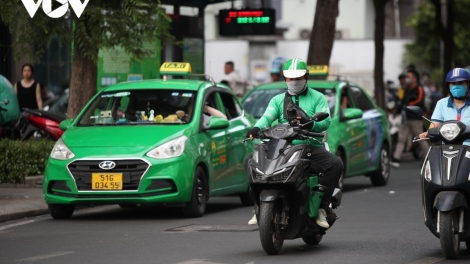
Juhern Kim: We've been doing the facilitation of the investment mobilization, policy advisory, and capacity development support. We’ll do the same, but strategically, starting this year. We want to be aligned with the top national agenda as much as we can – for instance, creation of the Vietnamese International Finance Center – and to make sure that finance mobilization is related to green projects. We want to support green finance for the success of the Vietnam International Finance Center. Transportation! The city governments of Hanoi and Ho Chi Minh City have a bold plan to electrify motorbikes this year. So, we wanted to help that be really successful following the government direction. Then the carbon market, we discussed. This is the first year. How can we help the participants of the carbon market from the steel industry, for example, learn more about new technologies and the new way of doing, in terms of greening, their own supply chain? So that’s our agenda. And then the national venture capital fund that the Ministry of Science and Technology is currently developing, we want to support that agenda in the context of promoting the climate tech and the green transition.
Bao Tram: In this implementation-heavy phase, what do you view as the biggest hurdle and how to tackle it if any?
Juhern Kim: I don't think there's a single roadblock. I think there are many bold policy actions already happening. In terms of policy, it's a matter of time. The overarching policy direction is that the new paradigm of growth for Vietnam be related to green and sustainable development. Let's say in 2026, 2027, we need to showcase small wins – electrification of the two-wheel motorbike or finance mobilization from the international market for green finance through the IFC. Can we do it? What is the early success? So we need to showcase that. Those are the success. What about the climate tech companies from Vietnam or the joint venture between Vietnamese companies and other countries? If we can collect more small wins, then those wins will move the entire industry towards net zero.
The 1 billion USD aims to help Vietnam accelerate its transition toward a low-carbon economy and meet ambitious sustainable development goals. But how big is the total green puzzle in the country?
• 368 billion USD is the total investment Vietnam needs by 2040 to reach its climate goals, according to the World Bank.
• 5% is the current share of green credit in Vietnam’s banking system—but it’s growing by 20% every year.
• 72 million is the number of motorbikes in Vietnam currently awaiting a "green" spark.
• 3 key sectors – steel, cement, and thermal power – are the first heavy hitters entering Vietnam's carbon market.
Bao Tram: A powerful note to end on. Thank you, Mr. Kim, for sharing your insights with us.
Juhern Kim: Thank you for having me.